Background
Following acute HIV infection, proviral DNA integrates into the genome and becomes latent. However, while the epigenetic mechanisms silencing proviral DNA likely present druggable targets for a cure, they remain poorly understood. The integrated HIV provirus interacts with host chromatin at distant sites. Therefore, we hypothesized that a 3D examination of these sites in CD4+ T cells would overlap with known binding sites for chromatin modulators in the human genome to reveal currently unknown regulatory and epigenetic targets.
Methods
Single cell (sc) Hi-C chromatin capture on a primary CD4+ T cell latency line was used to identify topologically associated domains (TADs) interacting with the provirus. TADs were overlaid with known binding sites for transcription factors across the human genome using the ReMap database, identifying putative targets modulating proviral expression, and STRING analysis revealed further associated chromatin modulators. Functional pathways for these targets were examined using Reactome. Two select targets were subjected to Single cell Cleavage Under Targets and Tagmentation (scCUT&Tag) in J-LAT 10.6 cells and CD4+ T cells isolated from a lymph node of a person with HIV to validate proviral binding alongside the repressive histone modification, H3K27me3.
Results
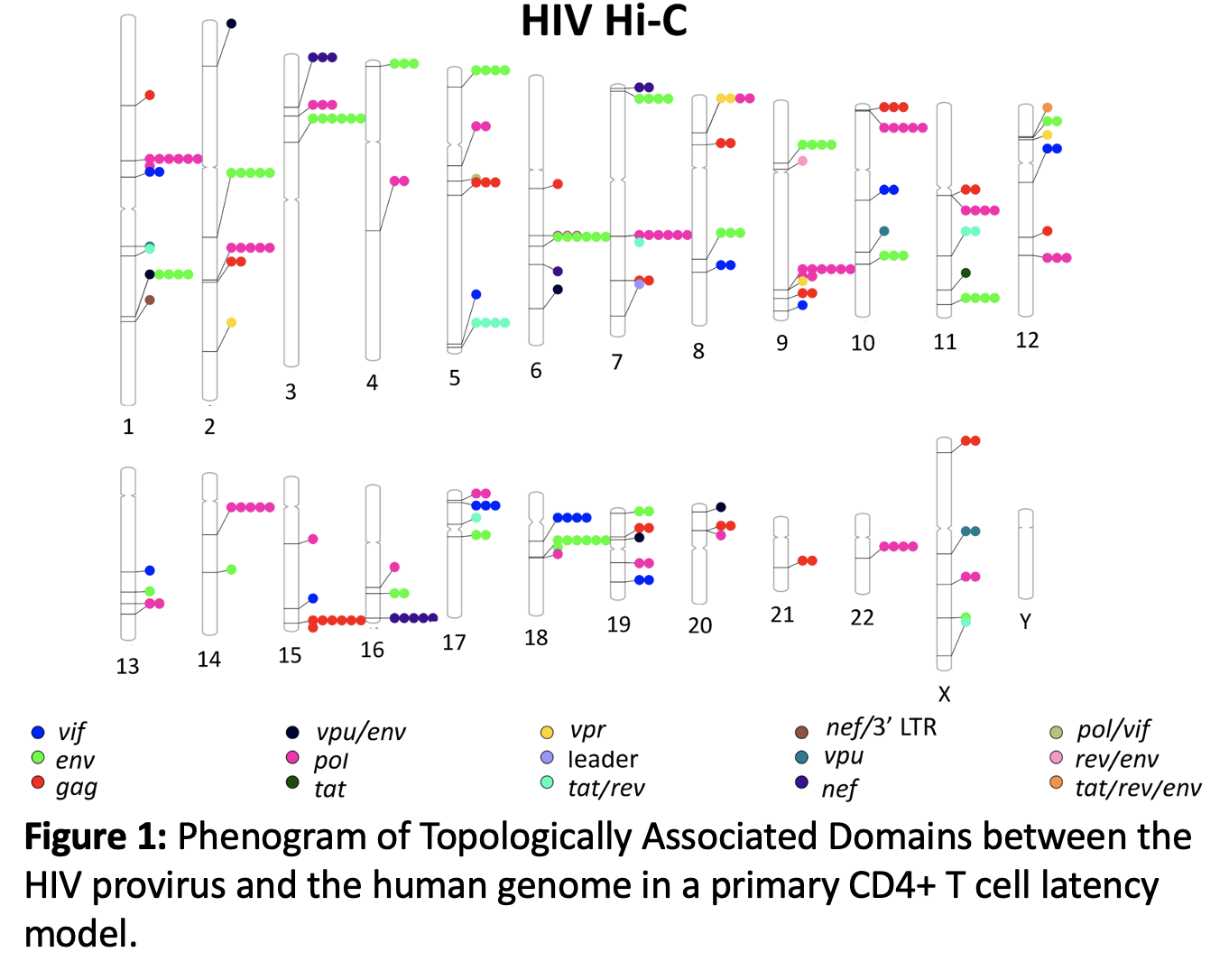
Hi-C analysis returned 236 TADs interacting with the HIV provirus (Figure 1). The ReMap overlay revealed 785 unique potential targets with binding sites in these TADs. Reactome analysis of the ReMap list showed enrichment of epigenetic regulation and chromatin remodeling pathways, including those regulating endogenous retroelements. BAF complex member DPF2 and DNA repair protein RAD21 were validated to bind the HIV provirus with scCUT&Tag in J-LAT cells and lymph node CD4+ T cells. CUT&Tag showed binding of RAD21 and DPF2 to the provirus, especially in the vpu/env region. The binding profile of DPF2 showed overlap with the original DPF2 TADs sequenced in the primary CD4+ T cell latency line, and STRING analysis of DPF2 returned several more factors overlapping with the Hi-C data.
Conclusions
Single cell Hi-C chromatin capture of a primary CD4+ HIV latency model revealed many putative epigenetic and chromatin modifying factors associated with HIV proviral regulation, both known and unknown. Validation of proviral binding by DPF2 and RAD21 using scCUT&Tag and corroboration using protein interaction analyses further identified novel putative chromatin modifying enzymes that regulate HIV reservoirs.
Table or Figure