Background
VH3810109 (N6LS) is a broadly neutralizing CD4-binding site antibody in development for ultra-long-acting HIV-1 treatment. The EMBRACE study evaluated efficacy, safety, and tolerability of N6LS every 4 months (Q4M) + monthly intramuscular long-acting cabotegravir (CAB LA) to maintain HIV-1 suppression. Month 6 results showed that intravenous (IV) and subcutaneous (SC) N6LS regimens maintained virologic suppression in 96% (IV) and 88% (SC) of participants with baseline N6LS sensitivity, with N6LS IV demonstrating a favorable safety and tolerability profile. Here, we present 12-month efficacy, safety, tolerability, and clinical outcome assessment results from a planned interim analysis of EMBRACE.
Methods
EMBRACE is a randomized, open-label, multicenter, phase 2b study in adults with HIV-1 RNA <50 c/mL and phenotypic sensitivity to N6LS (IC90 ≤2 μg/mL, maximum percent inhibition >98%). Participants were randomized 2:2:1 to N6LS 60 mg/kg IV + CAB LA, N6LS 3000 mg + recombinant human hyaluronidase PH20 (rHuPH20) SC + CAB LA, or to continue their pre-baseline standard-of-care (SOC) regimen. The primary endpoint was plasma HIV-1 RNA ≥50 c/mL at Month 6 (FDA Snapshot). The study was powered to ensure evidence of efficacy for failure rates from 2% to 6%.
Results
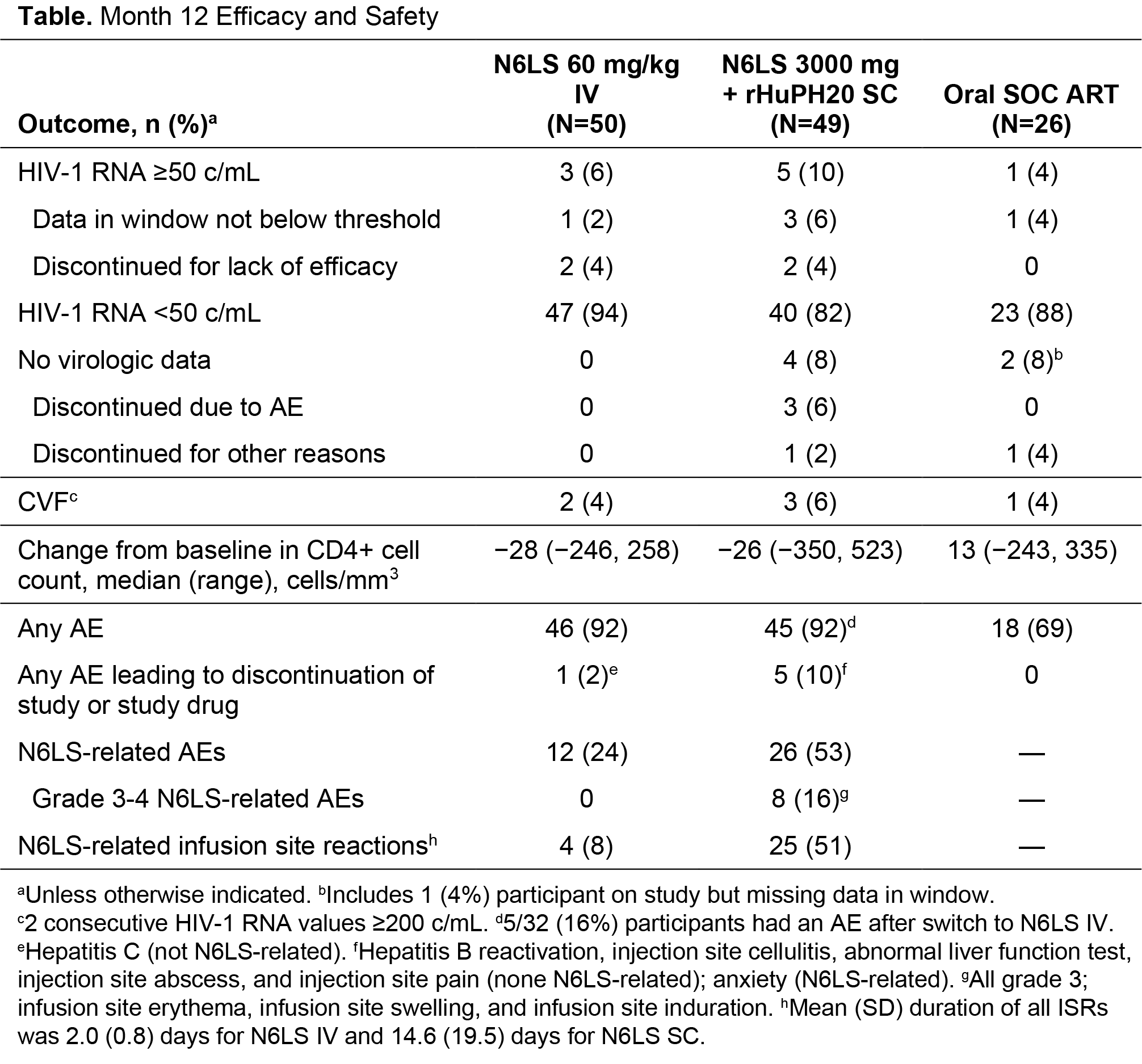
Overall, 125 participants were randomized; demographic data have previously been presented. Proportions with HIV-1 RNA ≥50 c/mL (FDA Snapshot) at Month 12 were 3/50 (6%) with N6LS IV, 5/49 (10%) with N6LS SC, and 1/26 (4%) with SOC (Table). Through Month 12, confirmed virologic failure (CVF) occurred in 2 (4%) participants receiving N6LS IV, 3 (6%) receiving N6LS SC, and 1 (4%) receiving SOC. Adverse events (AEs) leading to withdrawal occurred in 1/50 IV participants and 5/49 SC participants (N6LS-related AEs leading to withdrawal: IV, 0/50; SC, 1/49), with no N6LS-related serious AEs. Grade ≥3 N6LS-related infusion site reactions (ISRs) occurred in 0/50 (0%) IV participants and 8/49 (16%) SC participants. Despite safety differences, participants in both N6LS groups reported high tolerability and acceptability through Month 12.
Conclusions
N6LS IV Q4M maintained viral suppression in a high proportion of adults with baseline N6LS sensitivity and demonstrated a better tolerability profile than N6LS SC Q4M through 12 months of co-administration with monthly CAB LA.
Table or Figure