Background
The HIV-1 capsid inhibitor VH4011499 (VH-499) is currently in development as a long-acting antiretroviral agent for HIV-1. In a proof-of-concept study, oral VH-499 demonstrated rapid and potent antiviral activity in people with HIV-1 and was well tolerated. Here we present safety and pharmacokinetics (PK) findings from a first-time-in-human study assessing the ultra-long-acting (ULA) potential of an injectable VH-499 formulation.
Methods
In this double-blind (sponsor-unblinded) ongoing phase 1 study (NCT06724640), we randomized participants without HIV-1 to receive single ascending intramuscular (IM) or subcutaneous (SC) doses of VH-499 (100, 200, or 400 mg evaluated herein) or placebo. Safety and PK data were collected post-dose. Single-dose PK parameters using available data were evaluated by non-compartmental analyses.
Results
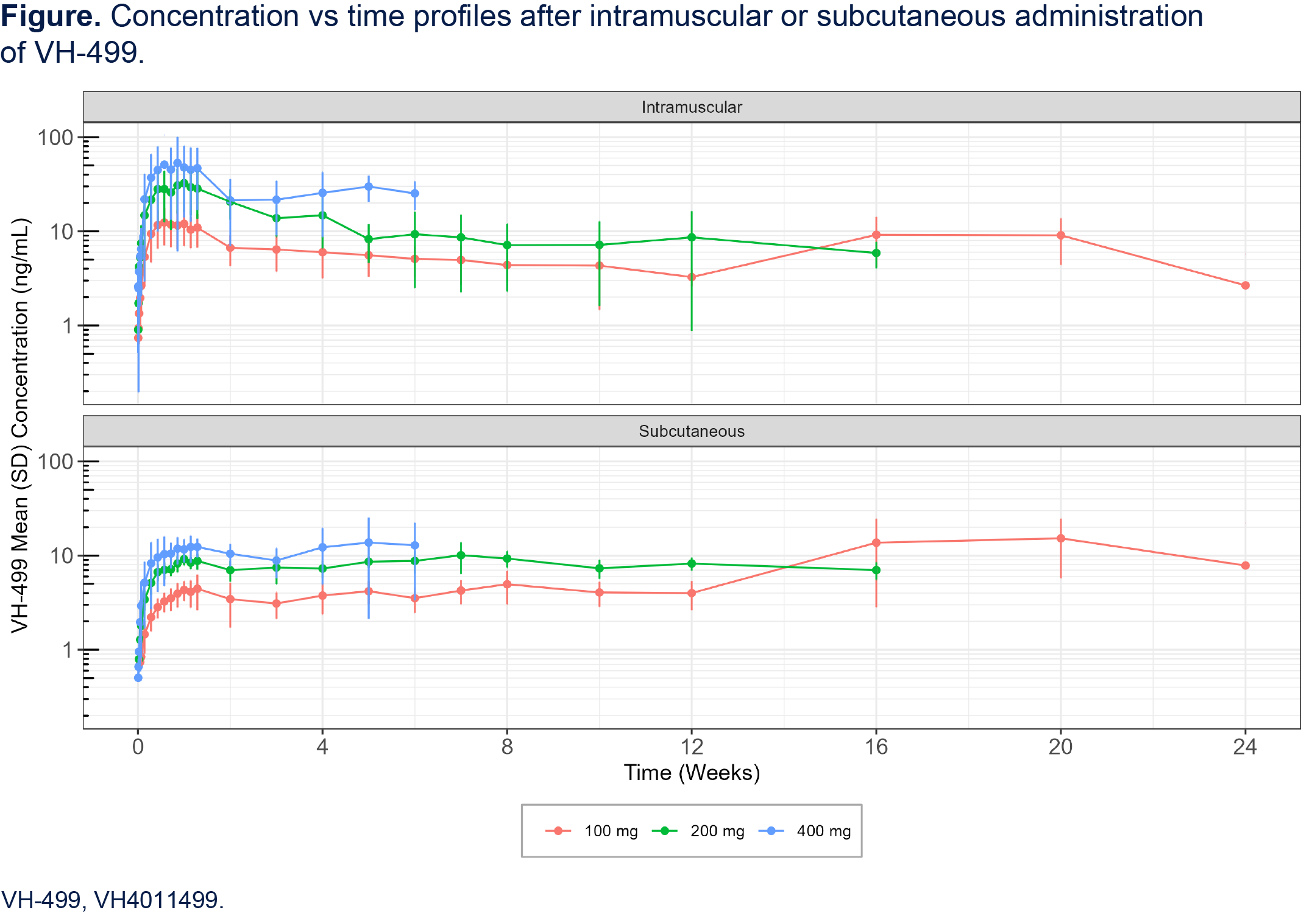
Overall, 48 participants received VH-499 or placebo as an IM or SC injection (6 groups total, n=8 each). Median age was 36 years, 94% of participants were male, and 40% identified as non-White. Most adverse events (AEs) had a maximum grade of 1 or 2 in severity across all treatment groups. VH-499–related AEs were primarily injection site reactions (ISRs), most frequently injection site pain (27/36; 75%). Median overall ISR event duration ranged from 1 to 3 days across all groups. Frequency of VH-499–related ISRs was higher in SC vs IM groups (83%-100% vs 33%-83%). No participants withdrew for safety reasons. No serious AEs were reported. Based on preliminary PK analysis, median time to maximum VH-499 concentration (tmax) was approximately 7 to 18 days post-dose for IM; tmax was approximately 112 days post-dose for SC due to slower absorption (Figure). Maximum VH-499 concentrations were lower after SC administration compared with IM at all doses. Given the relatively flat VH-499 PK profile for both IM and SC routes, no terminal half-life could be identified based on available data, and longer-term PK data are required.
Conclusions
Both IM and SC single-dose injections of VH-499 were well tolerated and demonstrated slower absorption through SC administration in people without HIV-1. These results suggest that the long-acting injectable VH-499 formulation has the potential to support ULA (ie, ≥4 months) dosing intervals, and either healthcare provider or self-administration could be feasible. Model-informed drug development approaches using emerging PK and safety data from this study will help to optimize the design of the future development of VH-499.
Table or Figure