Background
The manifestations of HIV-related cardiovascular disease (CVD) differ between global regions. Although heart failure (HF) with reduced ejection fraction dominated the pre-antiretroviral therapy (ART) era in South Africa (SA), the effect of HIV on HF risk and phenotype in the contemporary ART era is not well characterized. We estimated HF frequency and phenotype among people with HIV (PWH) in SA.
Methods
In a cross-sectional study in Khayelitsha, we recruited PWH of age ≥40 years on ART, and controls without HIV, targeting similar frequencies of age ≥50 years, female sex and hypertension. Participants underwent a clinical assessment, echocardiography (Echo), and measure of b-type natriuretic peptide (BNP). Echo parameters defined structural abnormalities of the left atrium and left ventricle (LV), increased LV filling pressure, and LV systolic and diastolic dysfunction. HF was defined by symptoms or BNP ≥35pg/mL combined with Echo criteria for diastolic or systolic dysfunction, and characterized as reduced, mid-range, or preserved ejection fraction (HFrEF, HFmidEF, and HFpEF). Comparisons between groups were adjusted for age, sex, hypertension, smoking, obesity, diabetes, elevated LDL, and hazardous alcohol use.
Results
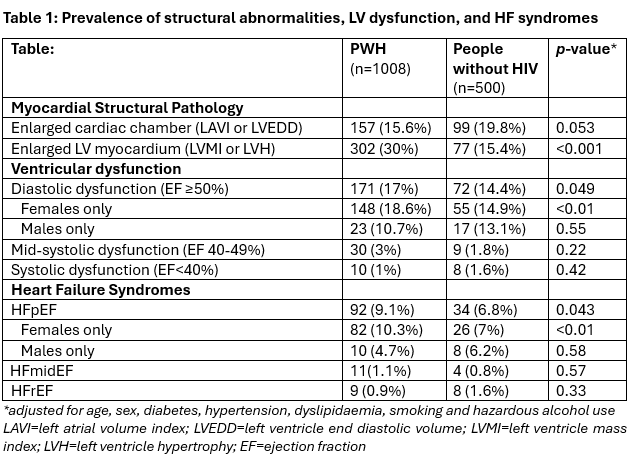
Between September 2022 and August 2025, we enrolled 1008 PWH (median (IQR) age 47 (43-52) years, 79% female) and 500 controls (median (IQR) age 48 (43-56) years, 74% female). Of the 1508 participants, 38% had hypertension, 29% were current smokers, 42% had obesity, 12% had diabetes, 13% elevated LDL cholesterol, <1% with known ischemic heart disease, 1% with chronic kidney disease, and 28% with hazardous alcohol use (AUDIT survey ≥8). The proportion with ≥1 HF risk factor was 63% among PWH and 68% in controls, with controls more likely to have obesity, diabetes or elevated LDL levels. Compared to controls, PWH had higher rates of LV hypertrophy or increased LV mass index (OR 2.7; 95%CI 2.0-3.6), diastolic dysfunction (OR 1.4; 95%CI 1.0-1.9) and HFpEF (OR 1.6; 95%CI 1.0-2.5), which was the most common HF phenotype. The excess risk among PWH was confined to women (OR 2.0; 95%CI 1.2-3.3) and absent among men (OR 0.8; 95%CI 0.3-2.1).
Conclusions
In a SA community with low socioeconomic status and a high burden of CVD risk factors, undiagnosed HFpEF and its precursors were more common among PWH than controls. Differences in HFpEF by HIV status were driven by substantial effects among women. Myocardial pathology was characterized by greater LV mass and diastolic dysfunction.
Table or Figure