Background
Alcohol-serving venues are high-risk sites for HIV transmission in East Africa. However, the preferences of venue patrons and workers for biomedical HIV prevention services are unknown.
Methods
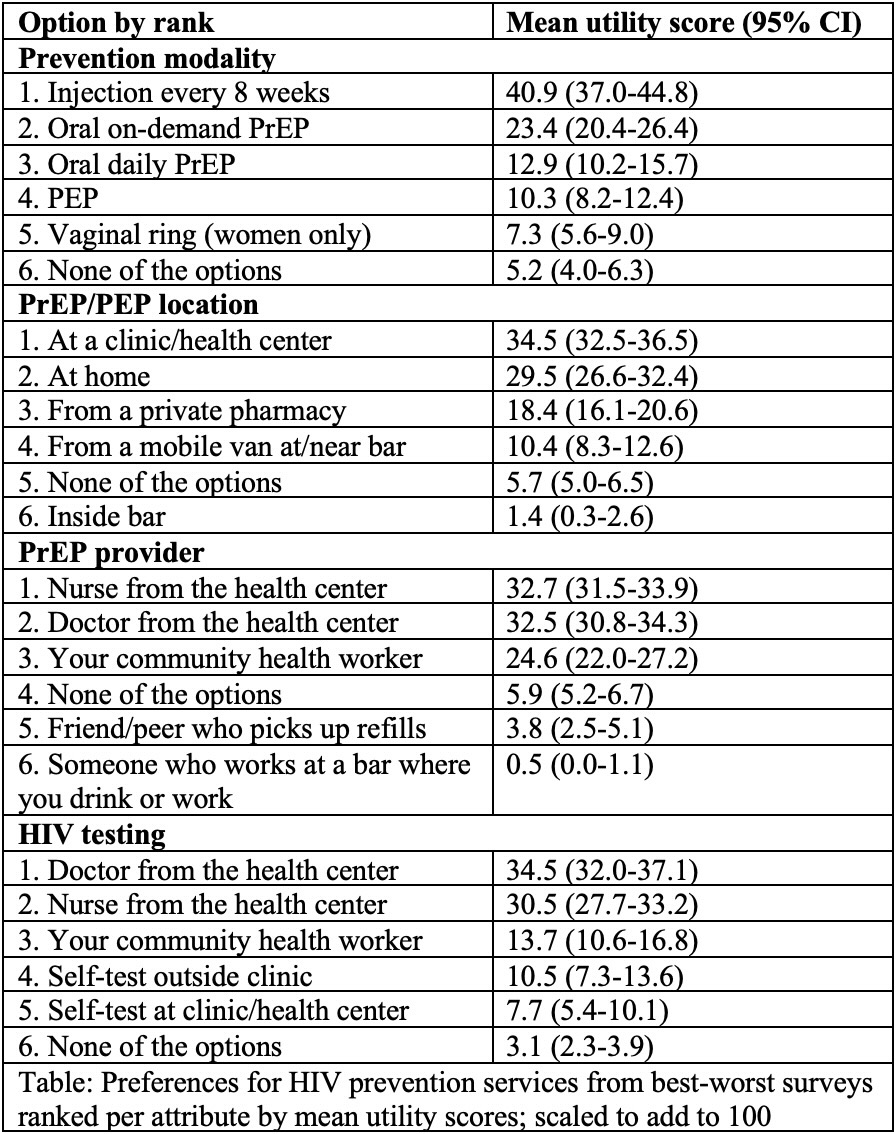
The OPAL trial (NCT05862857) recruited adults (age ≥18) at alcohol-serving venues in 8 rural communities in Kenya and Uganda (4/country) from 2023-25. Enrolled adults (n=7,744) completed clinic-based HIV screening, a survey assessing 3-month unhealthy alcohol use [Alcohol Use Disorders Identification Test-Consumption (AUDIT-C) score (≥3 women; ≥4 men)] and HIV risk (self-perceived or reported sexual risk behavior) and were referred to pre- or post-exposure prophylaxis (PrEP/PEP) or antiretroviral therapy. In a subset of those who tested HIV-negative, we conducted best-worst scaling (BWS) surveys in a stratified random sample of those who did or did not start PrEP/PEP. The BWS survey evaluated preferences on attributes of prevention services, including modality (e.g. injectable vs oral PrEP), location, provider, and HIV testing. Participants were prompted to select the best and worst choice from six, 3-option permutations per attribute (6 options/attribute [Table]). We used Hierarchical Bayesian models to generate mean utility scores reflecting weighted preferences of the study population.
Results
Of 81 BWS survey participants, 56 (69%) initiated and 25 (31%) declined PrEP/PEP, 52 (64%) were Kenyan, 39 (48%) female, 18 (22%) age 15-24, 21 (26%) single, 66 (82%) patrons and 14 (18%) workers, 54 (67%) reported unhealthy alcohol use, and 61 (75%) reported HIV risk. Participants preferred injectable PrEP nearly twice as much (mean utility score 40.9 [95%CI 37.0-44.8]) as the 2nd ranked option of on-demand PrEP (23.4 [20.4-26.4]; Table). Receiving no prevention services was the least favored option. Participants preferred to receive PrEP/PEP and HIV testing from doctors/nurses at health centers, though receiving services from community health workers and at home also scored high. Receiving PrEP at a bar or from a bar worker were least favored options.
Conclusions
Patrons and workers of alcohol-serving venues in rural East Africa expressed high interest in injectable and on-demand PrEP with service delivery at clinics or in the community, but not at alcohol-serving venues where they socialize or work. Offering expanded choice of prevention modalities and community-based services for this high-risk population merits further evaluation.
Table or Figure