Background
Doxy-PEP is an effective strategy for STI prevention, with absent data from Latin America. ImPrEP (2018–2021) evaluated same-day oral PrEP delivery for MSM and TGW in Brazil, Mexico, and Peru. STI burden was high (31·7 cases per 100 person-years), with nearly one-third of participants accounting for all diagnoses. While doxy-PEP efficacy is established, its optimal prescribing approach in real-world settings remains uncertain. In this analysis, we modeled and compared the potential impact, efficiency, and antibiotic consumption of alternative doxy-PEP prescribing approaches using ImPrEP data.
Methods
ImPrEP participants were HIV-negative MSM and TGW ≥18 years, under high HIV vulnerability. For this analysis, we included only those with ≥2 STI assessments. Using observed STI diagnoses, (syphilis, chlamydia and gonorrhea), we modeled doxy-PEP use and averted STI diagnoses under three counterfactual prescribing strategies: (S1) initiation at baseline regardless of STI test; (S2) initiation after any positive STI test during follow-up; and (S3) initiation after any positive STI test at baseline. Averted diagnoses were estimated by multiplying observed incidence by doxycycline efficacy from clinical trials. Strategy efficiency was assessed through the number needed to treat (NNT), defined as person-years of doxy-PEP use divided by diagnoses averted. Antibiotic consumption was expressed as monthly Defined Daily Doses (mDDD) per WHO standards, accounting for doxy-PEP use, estimated assuming an uptake of 75% and median use of 4 doses/person/month, and averted STI treatments.
Results
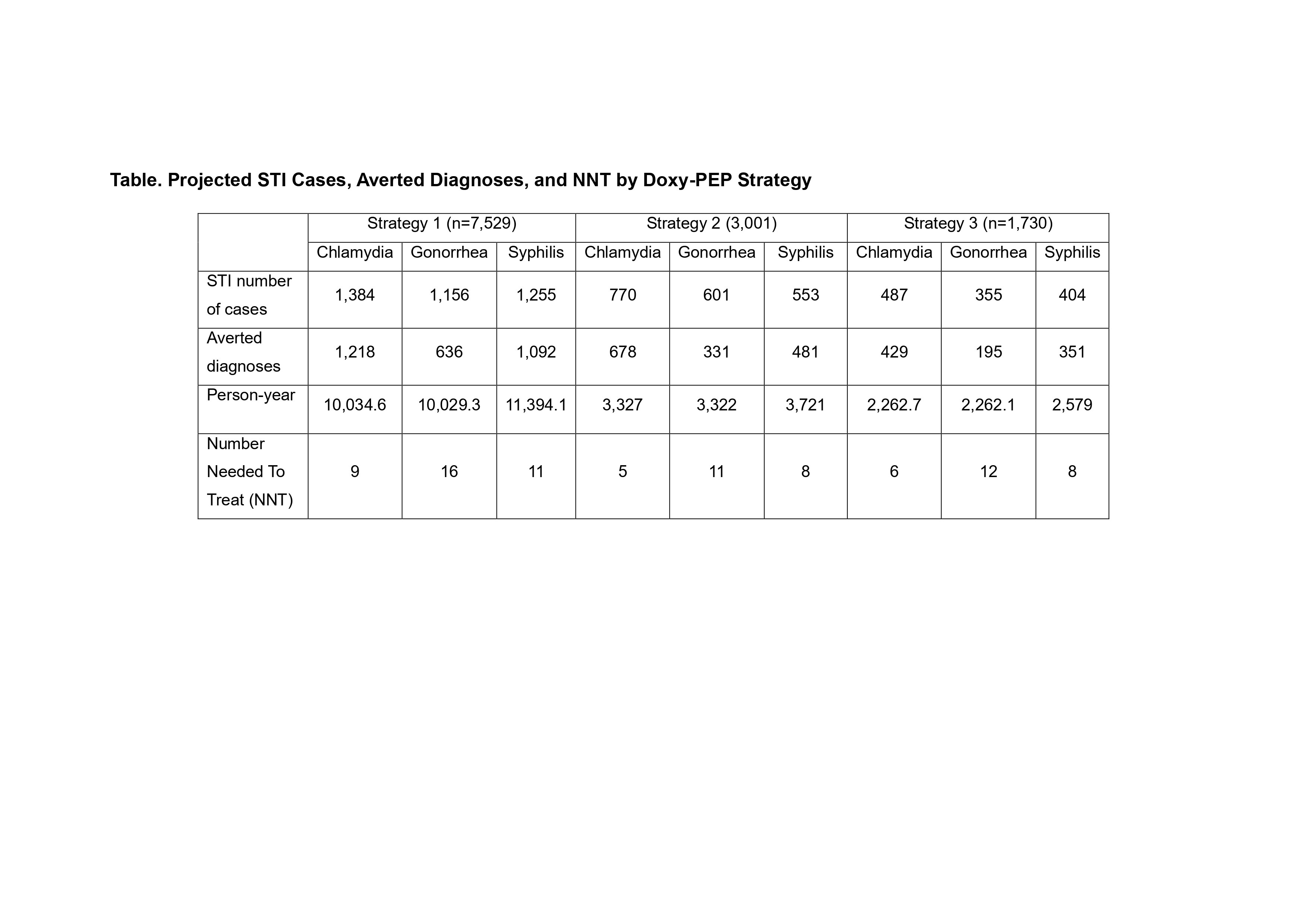
Of 7,529 participants included (95.4%: MSM; 70.9% non-white; median age: 29 years), 100% would receive doxy-PEP under S1, compared to 39.9% under S2 and 23% under S3. Among 3,795 observed incident STIs, S1 was projected to avert 77.6% of diagnoses versus 39.2% with S2 and 25.7% with S3. NNT was consistently higher in S1 than in S2 or S3 across all pathogens (Table). Estimated antibiotic consumption corresponded to a net increase of 22,185 mDDD in S1 compared to 8,721 mDDD in S2 and 5,053 mDDD in S3.
Conclusions
In a population with high STI vulnerability, universal doxy-PEP under S1 could substantially reduce STI incidence but is associated with higher NNT and greater antibiotic consumption compared to S2 and S3. Our results suggest that diagnosis-triggered strategies may offer a more efficient and rational approach to doxy-PEP use.
Table or Figure