Background
Approximately 13% of people with HIV are unaware of their HIV status. Distribution of HIV self-tests (HIVSTs) to populations most affected by HIV increases awareness of infection, and may facilitate initiation of treatment. Previous work has described HIVST distribution programs, but not confirmation of diagnosis or engagement in antiretroviral therapy (ART).
Methods
A national CDC-funded HIVST distribution program was launched in 3/2023. People ≥ 17 years old who reside in the US or Puerto Rico ordered 1 or 2 HIVSTs online. Program participants were asked to complete a short post-order survey. Participants who consented to future communications were emailed survey links 10 and 60 days after the HIVSTs were mailed. Data included demographic information, prior HIV testing and diagnosis, HIVST results, subsequent provider testing and ART initiation. Surveys were not compensated.
Results
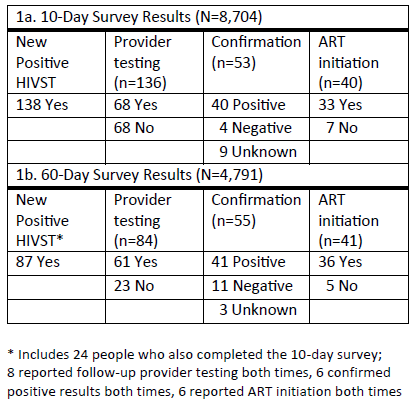
From March 2023 through May 2024, 250,083 people placed their first order for one (15%) or two (85%) HIVSTs; 78% responded to the post-order survey. Survey response rates were: 3.5% on the 10-day and 1.9% on the 60-day, with 0.6% answering both. Among the 12,037 who answered 10- or 60-day survey questions, most responded within 2 days, 294 (2.4%) reported a prior HIV diagnosis in the post-order survey, of whom 154 later used the HIVST. Among the remaining 11,743, 201 (1.7%) reported a positive HIVST; most of whom were male (65%) and <35 years of age (54%). Among 138 people with a new positive HISVT on the 10-day survey, 68 sought testing from a medical provider, of whom 44 reported the test result; 40 (91%) were confirmed positive, and 33 of 40 (83%) initiated ART (Fig 1a). On the 60-day survey, there were 87 respondents reporting a new positive HIVST, including 24 who also completed a 10-day survey. Sixty-one were tested by a provider ≤30 days of using the HIVST, 52 reported the result, of whom 41 (79%) were confirmed positive, and 36 of those 41 (88%) initiated ART (Fig 1b). Integrating data from both timepoints, among the 201 people with a new positive HIVST, 121 were tested by a provider, 75 were confirmed to have HIV, and 63 initiated ART.
Conclusions
HIVST programs increase awareness of HIV infection. This limited program evaluation illustrates that many participants with positive HIVSTs followed up with provider testing. Strengthening messaging on the need for laboratory testing may be required. Among people with a confirmatory diagnosis, most initiated ART, preventing further HIV transmission.
Table or Figure