Background
Despite the availability of oral HIV pre-exposure prophylaxis (PrEP), gaps remain in reaching the UNAIDS target of 21.2 million people on PrEP by the end of 2025 and reducing HIV incidence. The U.S. President’s Emergency plan for AIDS Relief (PEPFAR) is leading the rollout of long-acting PrEP in high-burden settings, which provides an opportunity to increase PrEP uptake and curb new HIV infections globally. In 2024, PEPFAR-supported injectable cabotegravir (CAB-LA) was introduced to expand HIV prevention options in five initial countries.
Methods
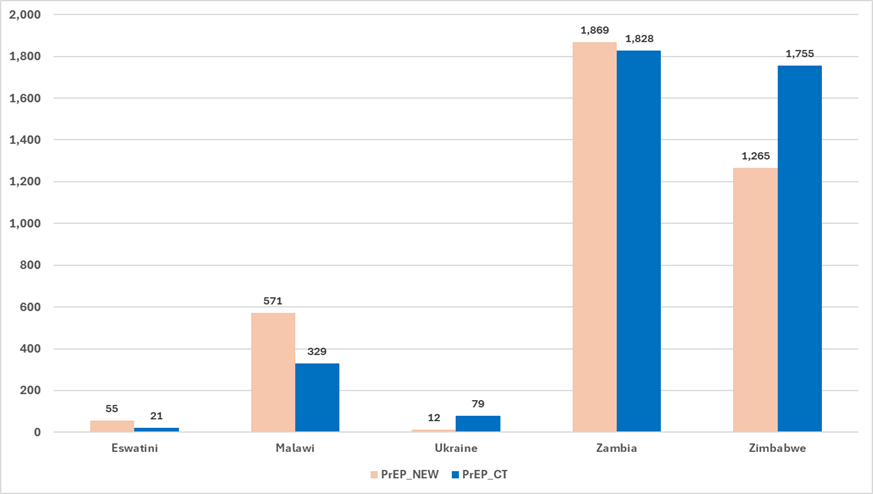
CAB-LA was introduced in 105 facilities in 45 districts across Zambia, Malawi, Zimbabwe, Eswatini, and Ukraine in the first three quarters of 2024. We assessed fiscal year (FY) 2024 Monitoring, Evaluation, and Reporting (MER) data on PrEP_NEW (number of PrEP naive individuals initiated on PrEP) and PrEP_CT (number of individuals who returned for PrEP at least once that quarter, or who switched from oral PrEP to CAB-LA), disaggregated by PrEP type (injectable) from February to September 2024. Qualitative data on facilitating factors and challenges with CAB-LA implementation was collected through a monthly PEPFAR CAB-LA collaborative with country teams.
Results
Across the five countries, 3,772 PrEP-naïve clients initiated CAB-LA (Figure 1). By the end of September 2024, a total of 4,932 clients were on CAB-LA. Initial populations for early CAB-LA access varied by country and included key populations, adolescents and young adults, and men at higher risk. Country teams reported that clients were generally satisfied with the product and found it acceptable. Teams also indicated that government and political leadership, supportive policies, and capacity building facilitated implementation of CAB-LA. Training for clinical teams on options-based counseling, addressing client concerns, and providing clients with appointment reminders was also critical. A key limitation of this analysis is the reliance on aggregate data, which limits the ability to assess individual-level factors influencing CAB-LA uptake and persistence on treatment over time.
Conclusions
Long-acting PrEP presents an opportunity to accelerate towards ending the HIV pandemic as a public health threat by 2030. Lessons learned from early CAB-LA introduction will inform continued scale-up of CAB-LA in additional PEPFAR-supported countries in 2025, with plans to reach 100,000 clients by the end of the year. This platform will also support future HIV prevention products including Lenacapavir.
Table or Figure