Background
First-time testers are often overlooked by conventional HIV services, yet they play a critical role in achieving the goal of ensuring all at-risk individuals know their status. Online platforms—such as TikTok and LINE—offer accessible, anonymous, and engaging options to reach these groups, especially at-risk adolescents and young adults. By leveraging digital channels, innovative HIV self-testing (HIVST) initiatives can connect with those reluctant to HIV testing.
Methods
The ‘Stand by You’ initiative integrated free HIVST, online text-based counseling, and educational support on HIV prevention, covering pre- and post-exposure prophylaxis (PrEP, PEP), facilitating linkage to care. TikTok ads targeted at-risk adolescents and young adults. After completing a self-administered risk assessment questionnaire, eligible individuals received HIVST kits by mail and were encouraged to voluntarily report their HIVST results without incentives. Instant text-based chatroom counseling (from 10:00–22:00) provided guidance and support on HIV and STI-related issues. Data from August 25, 2022, to December 31, 2024, were analyzed to describe the characteristics of first-time testers and identify factors associated with a positive HIVST result.
Results
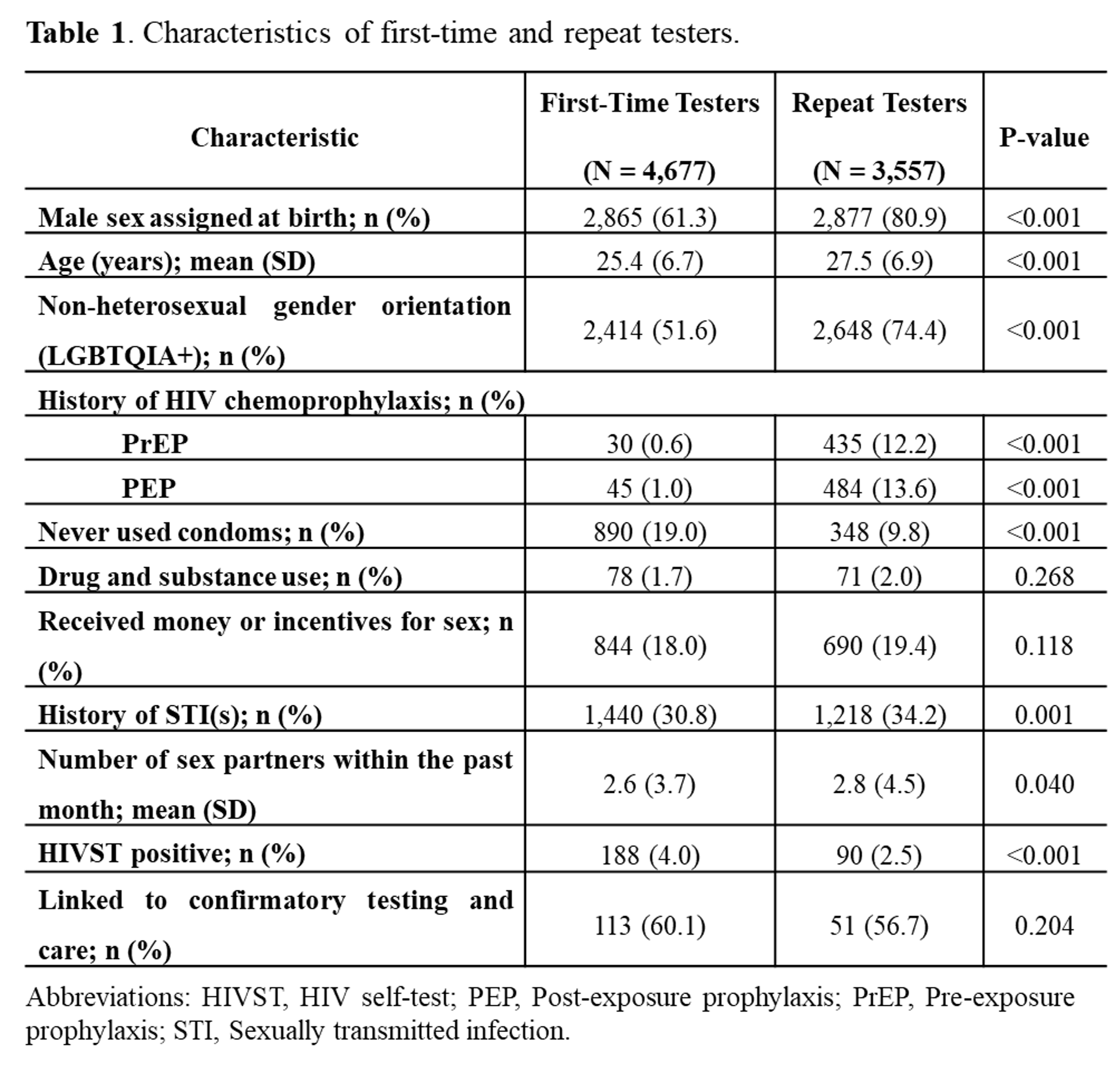
Among 8,234 participants, 4,677 (56.8%) were first-time testers. Compared with repeat testers, first-time testers were younger (under 25 years old 54.3% vs. 39.4%, P<0.001), less likely to identify as LGBTQIA+ (51.6% vs. 74.4%, P<0.001), and less likely to use HIV chemoprophylaxis (PrEP 0.6% vs. 12.2%; PEP 1.0% vs. 13.6%, P<0.001). They also reported lower condom use, had a slightly lower average number of sexual partners in the past month (2.6 vs. 2.8, P=0.04), and exhibited a higher HIV positivity rate (4.0% vs. 2.5%, P<0.001). In multivariable analysis, factors significantly associated with a positive HIVST result among first-time testers included identifying as LGBTQIA+ (adjusted odds ratio [aOR] 7.41, 95% CI: 4.82–11.39, P<0.001), having a history of sexually transmitted infections (aOR 1.86, 95% CI: 1.37–2.53, P<0.001), and being older (aOR 1.03 per year increase, 95% CI: 1.01–1.05, P=0.004).
Conclusions
First-time testers showed a higher risk of HIV infection, emphasizing the importance of digital outreach in closing HIV testing gaps. By offering convenient and stigma-free avenues, online platforms can expand HIVST uptake among at-risk groups—particularly those with no prior testing history—facilitating earlier detection and treatment.
Table or Figure