Background
Prior studies have shown that persons aging with HIV are at higher risk for sarcopenia. Several consensus definitions have been developed for sarcopenia based upon combined muscle mass, performance and strength assessments. Because these approaches are not practical for routine clinical settings, the 5-item SARC-F questionnaire was validated to screen for sarcopenia in the general population (GP) but has not yet been validated for people living with HIV (PLWH).
Methods
We conducted a cross-sectional study of PLWH aged ≥45 years at three HIV clinics in Lima, Peru between March 2022 to August 2023. Patients completed demographic and clinical surveys, the validated Spanish language SARC-F (score range: 0-10, score ≥4 indicating a high likelihood of sarcopenia or severe sarcopenia), the Short Physical Performance Battery, grip strength, and a dual-energy x-ray absorptiometry body composition scan for appendicular skeletal muscle index. Sarcopenia spectrum (presarcopenia, sarcopenia, and severe sarcopenia) was classified based on the European Working Group on Sarcopenia in Older People (EWGSOP 2019) and the Asian Working Group on Sarcopenia (AWGS) reference standards. Sex-based differences in presence of sarcopenia spectrum were analyzed using χ2 or Fisher’s exact tests. Validity of SARC-F to identify individuals with sarcopenia or severe sarcopenia, compared to EWGSOP 2019 and AWGS, was assessed with sensitivity, specificity, positive and negative predictive values (PPV/NPV), and area under the receiver operating curve (AUC).
Results
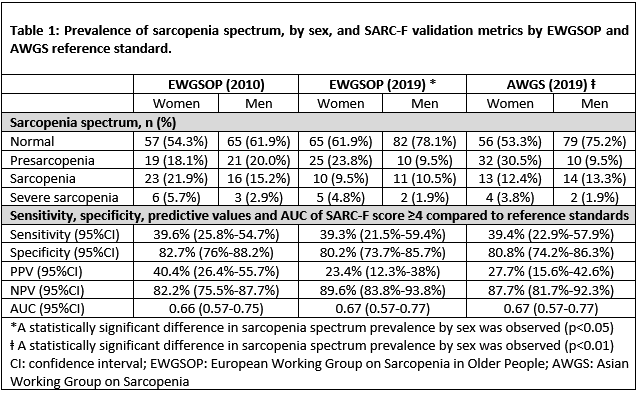
We enrolled 210 PWH, including 105 women, 105 men, with mean ages of 55.2±7.1 and 54.8±7.6, respectively. Sarcopenia spectrum prevalence was higher amongwomen compared with men based upon EWGSOP 2019 and AWGS. 22.7% of participants had a SARC-F score ≥4. Table 1 shows the validity results of SARC-F compared to each criterion.
Conclusions
In our study, using a cutoff of 4, SARC-F showed acceptable specificity, low sensitivity and low-moderate discrimination. Given sarcopenia spectrum was present in 30-35% of participants, further research is warranted to evaluate how SARC-F or other tools can support detection of sarcopenia in settings where multi-component tests are not feasible.
Table or Figure