Background
Intracellular tenofovir diphosphate (TFV-DP) concentrations from F/TDF PrEP in dried blood spots are ~30-50% lower during pregnancy, but data on TFV-DP levels achieved in peripheral blood mononuclear cells (PBMCs), the clinically relevant site for HIV prevention, are limited. We evaluated the effect of pregnancy on TFV-DP levels in PBMCs and birth and infant growth outcomes in cisgender women using F/TDF.
Methods
Directly observed daily F/TDF PrEP was administered to healthy 18 pregnant and 18 non-pregnant Kenyan women for 8 weeks (clinicaltrials.gov: NCT05057858). TFV-DP was quantified in PBMCs collected at week 2, 4, 6, and 8 using validated LC-MS/MS assays at the University of Colorado. Log transformed TFV-DP concentrations were compared between pregnant and non-pregnant groups using linear mixed models adjusted for age and week. Pregnancy outcomes and infant growth in the pregnant group were assessed at 1, 6, and 12 months postpartum and compared to historical controls from the placebo arm (no F/TDF PrEP exposure) of the Partners PrEP Study (NCT00557245).
Results
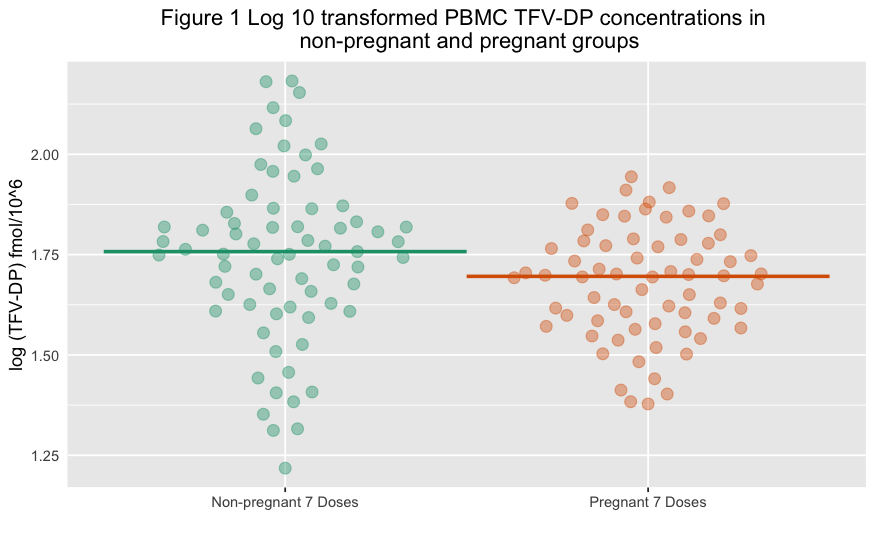
Median (IQR) baseline age and creatinine clearance estimated by cockroft-gault equation was 23 (IQR: 20-27) and 178 (152-198) mL/Min for pregnant and 23 (20-25) and 131 (113-146) mL/Min for non-pregnant women, respectively. For pregnant women, median gestational age was 16 (15-20) weeks. Overall, 137 steady state PBMC samples were analyzed: 68 in pregnant vs 67 in non-pregnant group. Observed geometric mean PBMC TFV-DP levels were 47.8 fmol/106 for pregnant vs 55.6 fmol/106 in non-pregnant women (Figure 1). Similarly, the fitted mean (95%CI) PBMC TFV-DP concentrations was 47.9 (40.7, 56.2) fmol/106 in pregnant vs 55.0 (47.9, 64.6) fmol/106 in non-pregnant women (p=0.17). No preterm birth or birth defects occurred in the PrEP exposed group. Mean Z-scores for length were comparable at 1 (-1.418 vs -0.789, p=0.2), 6 (-0.345 vs -0.754, p=0.3), and 12 (-0.604 vs -1.058, p=0.3) months after birth between groups. Mean Z-scores for weight and head circumference were also comparable between PrEP exposed and non-exposed populations up to one year of birth.
Conclusions
Steady state TFV-DP concentrations in PBMCs from directly observed therapy of daily oral F/TDF PrEP were reassuringly comparable in pregnant and non-pregnant African women. Consistent with previous studies, birth and infant growth outcomes up to one year were also comparable between PrEP-exposed and unexposed pregnancies.
Table or Figure