Background
The T cell receptor repertoire (TCR) plays a key role in immune surveillance and regulating inflammation. Alterations in TCR are linked to cognitive decline in Alzheimer’s Disease. In animal models, TCR affects neuronal plasticity and memory through T helper 2-mediated responses. By disrupting immune homeostasis, HIV can affect TCR and cognition. We assessed whether TCR is involved in cognitive performance among PWH
Methods
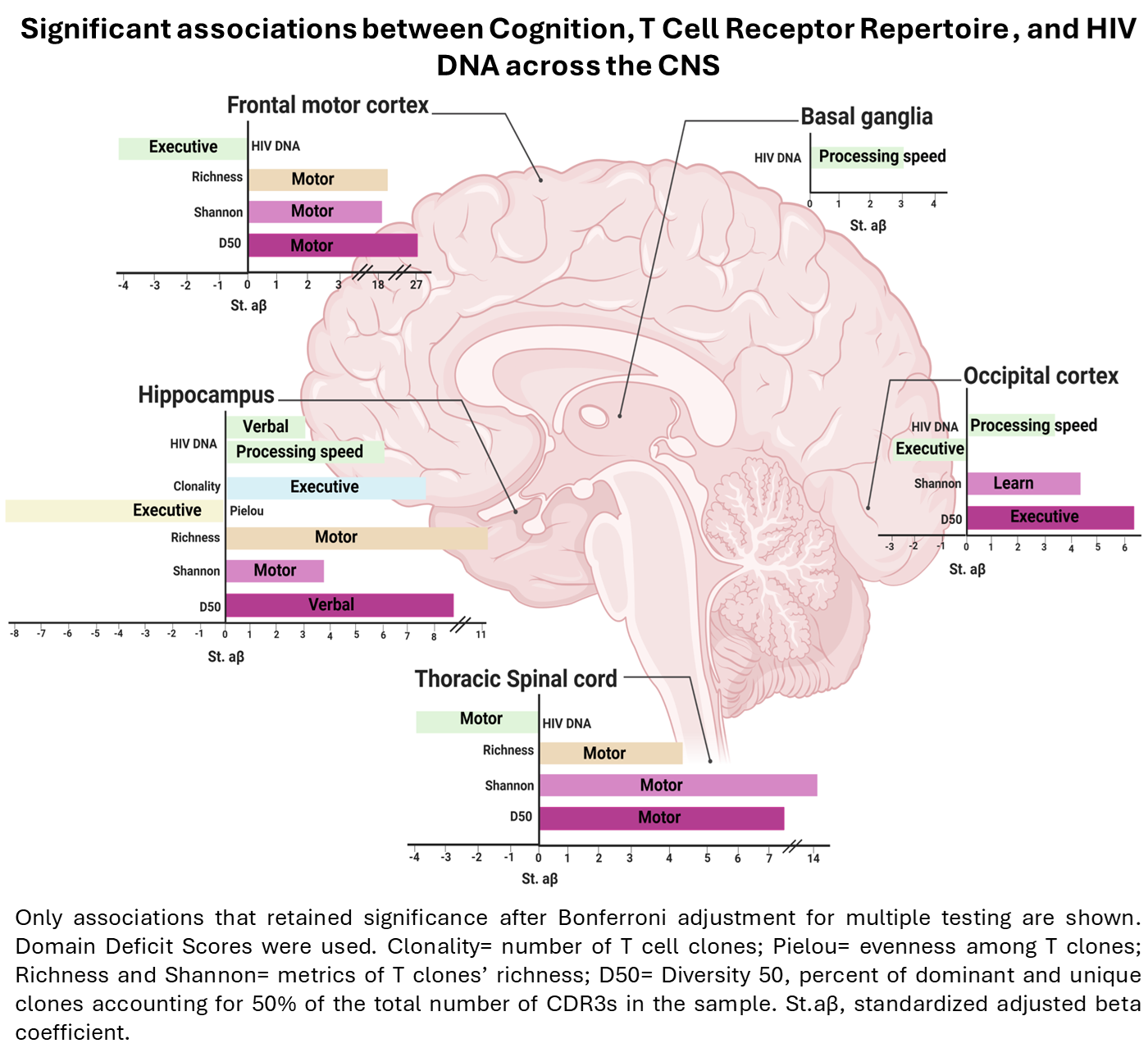
Bulk TCR sequencing (IMMUNOVerse TCR) and cell-associated HIV DNA (ddPCR) were performed on samples from 5 central nervous system (CNS) regions (basal ganglia BG, occipital cortex OC, frontal motor cortex FC, hippocampus HC, thoracic spinal cord SC) and peripheral blood mononuclear cells collected ≤6 hours post-mortem from 9 PWH enrolled in the Last Gift cohort. TCR data were analyzed using MIXCR for richness, diversity, and clonality. Cognitive function was assessed within a year of death. Associations between TCR, cognition, and HIV DNA were explored through generalized linear models adjusted for age, HIV RNA, CD4+ count and nadir. Bonferroni correction was applied
Results
Participants were aged 65±8 years, with median CD4+ count 330 cells/µL, and 8/9 were white, male, with plasma HIV RNA<40 cp/mL. Cognitive assessment occurred within a median of 5 months of death. While HIV DNA and TCR richness/diversity did not differ across CNS regions, TCR clonality did (p=0.038): the highest clonality in SC and PBMCs and the lowest in FC. HIV DNA levels were not associated with TCR characteristics. Higher TCR richness/diversity in FC, HC, OC, and SC was linked to poorer performance in learning, verbal, executive, and motor domains (adj.p<0.01 all). Higher TCR clonality in HC was associated with worse executive function (adj.p<0.01; Fig.1). No associations were found between TCR in the blood and cognitive performance. Higher HIV DNA correlated with slower processing speed (BG, HC, and OC) and poorer verbal function (HC), but also with improved executive and motor functions (FC, OC, and SC; Fig.1). Removing the single participant with detectable HIV RNA did not change the findings
Conclusions
This is the first evidence of an interaction between TCR in the CNS and cognitive performance in PWH. The absence of associations between HIV reservoir and TCR, along with the different relationships of TCR and HIV DNA with cognition highlight the complexity of the CNS viroimmune environment and suggest drivers other than HIV behind the link of TCR with cognition (e.g., co-infections)
Table or Figure