Background
HIV infection causes overexpression of sialic acid on the surface of infected cells, which binds to Siglecs—immune inhibitory receptors on innate immune cells such as natural killer (NK) cells and monocytes. This interaction triggers inhibitory signals in these immune cells that contribute to the ability of HIV-infected cells to evade immune surveillance. To counter this, we developed a targeted immunotherapy by conjugating sialidase, an enzyme that removes sialic acid, to the HIV antibody 10-1074 (referred to as 10-1074-Sia). This approach directs sialidase to HIV+ cells expressing Env antigen, stripping sialic acid from the infected cell surface and enhancing their immune elimination. We tested this strategy in vivo using a humanized mouse model of HIV infection.
Methods
Five weeks old immunodeficient NSG mice (n=15) were humanized by engrafting memory CD4+ T cells from healthy donors. Mice were infected with HIV-1SUMA, and a week later, were treated weekly for 5 weeks with either: 1) PBS (control), 2) 10-1074 combined with autologous NK cells and monocytes, or 3) 10-1074-Sia combined with autologous NK cells and monocytes. Plasma viral load and CD4+ T cell counts were monitored longitudinally by qPCR and flow cytometry, respectively. Human cytokine levels (e.g., TNFα, IFNγ, IP10) were measured longitudinally using multiplex arrays.
Results
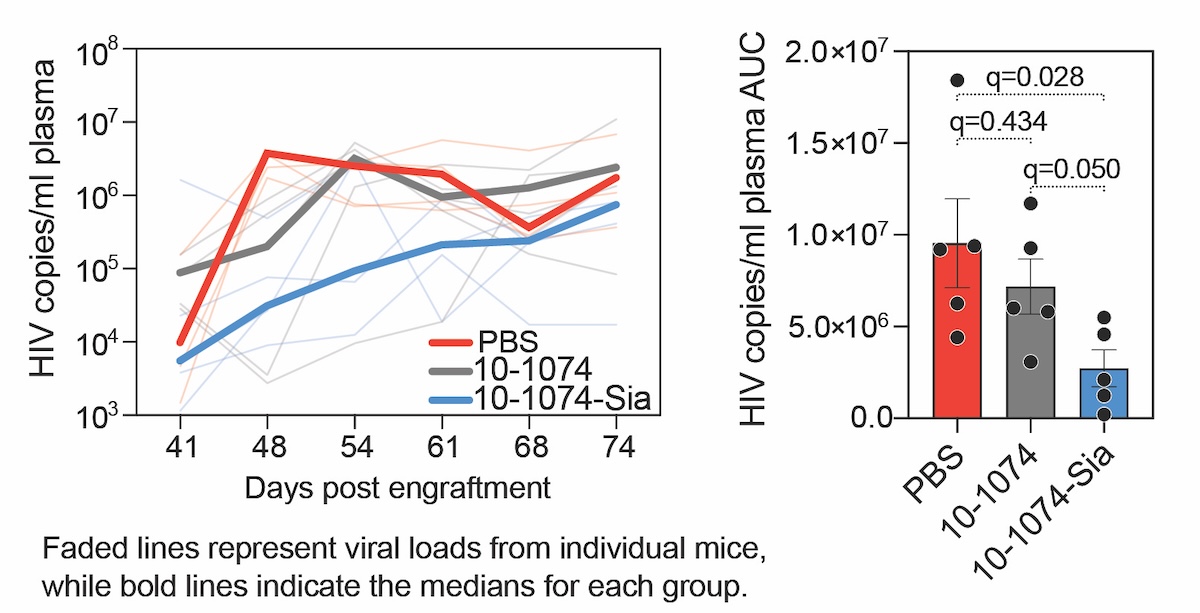
Mice treated with 10-1074-Sia did not experience significant weight loss compared to PBS-treated mice (q=0.87). While 10-1074 treatment alone was insufficient to significantly reduce viral load compared to PBS-treated mice (q=0.43), 10-1074-Sia demonstrated superior efficacy in reducing viral load (q=0.028 compared to PBS control and q=0.05 compared to 10-1074). CD4+ T cell depletion was reduced in mice treated with 10-1074 (p=0.028) or 10-1074-Sia (p=0.08) compared to controls. Finally, while 10-1074 was unable to reduce HIV-associated inflammation, 10-1074-Sia significantly reduced HIV-induced inflammation markers such as TNFα (p=0.02), IFNγ (p=0.001), IP10 (p=0.01), and MIP1α (p=0.03).
Conclusions
Conjugating sialidase to 10-1074 significantly enhanced the antibody’s immune-potentiating effects, resulting in superior viral load control and improved inflammatory responses. These findings highlight 10-1074-Sia as a promising anti-HIV immunotherapeutic strategy. Further investigation into combining this approach with strategies such as shock-and-kill is warranted to explore its potential for eliminating infected cells during antiretroviral therapy.
Table or Figure