Background
Initiation of integrase strand-transfer inhibitors (INSTIs) is associated with body weight gain in women with HIV (WWH); however underlying mechanisms are unclear. Leveraging samples from the Women’s Interagency HIV Study (WIHS) cohort, we performed serial high-throughput untargeted metabolomics to determine metabolic signatures associated with INSTI-related weight gain.
Methods
This study included virologically suppressed (<200 c/mL) WWH on antiretroviral therapy (ART) and women without HIV (WWoH) enrolled in WIHS. We compared weight change among WWH who switched/added an INSTI with those who remained on non-INSTI ART and with WWoH (weight gain, defined as ≥5% change from baseline, versus weight maintenance, defined as <5% change). Serum samples were collected from three time points: 6-12 months prior to switching to or adding an INSTI (baseline), 1-6 months post-switch/addition, and 1-2 years post-switch/addition, with equivalent time points for the non-INSTI and WWoH. Samples were analyzed with liquid chromatography-mass spectrometry-based high-resolution metabolomics (HRM). Differences between weight change groups were assessed using linear mixed-effect models, adjusted for baseline age and body mass index (BMI) and stratified by ART exposure. Metabolic pathway enrichment analysis was performed on significant metabolites using the mummichog algorithm.
Results
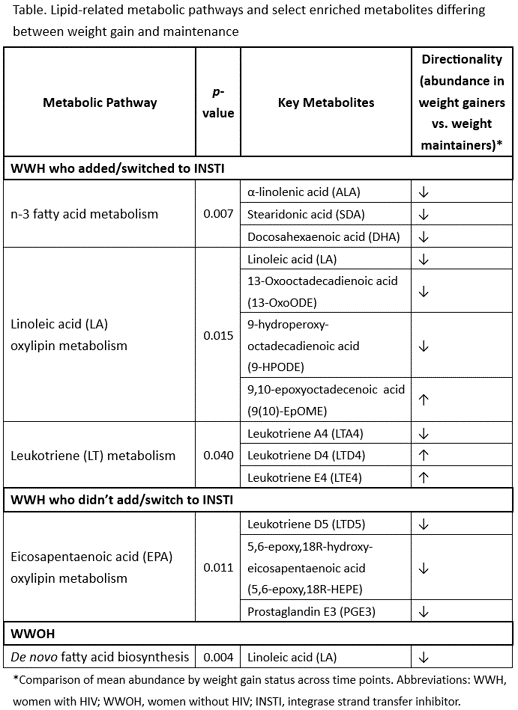
N =191 women, aged 25-70 years, were included (n=37 INSTI, n=88 non-INSTI, n=66 WWOH; 70% Black; 30% White or other ethnicities). In the INSTI group, 830 metabolites enriched within 12 metabolic pathways differed between weight gainers and maintainers (p<0.05). INSTI-specific pathways included n-3 polyunsaturated fatty acid (PUFA), linoleic acid (LA) oxylipin, and leukotriene metabolism (p<0.05, Table), wherein most of metabolites were higher at baseline in weight maintainers and remained elevated. Eicosapentaenoic acid metabolism differed by weight gain in the non-INSTI group. In WWOH, no PUFA or oxylipin-related metabolism was found, except for LA, which was enriched in de novo fatty acid biosynthesis.
Conclusions
Untargeted HRM identified pathways related to anti- and pro-inflammatory lipid metabolism that were specific to INSTI-related weight gain, indicating a metabolic profile that may be vulnerable to weight gain after INSTI switch/addition for WWH. Further research is needed to reveal underlying biological mechanisms of INSTI-related weight gain.
Table or Figure