Background
“Retention” in care is a key health monitoring benchmark among people with HIV (PWH). However, not all retention metrics predict important downstream outcomes, particularly with decreasing frequency of clinical monitoring. We therefore assessed the association of multiple retention metrics with mortality in the North American AIDS Cohort Collaboration on Research and Design (NA-ACCORD).
Methods
Adult (age ≥18 years) PWH in care at NA-ACCORD clinical sites from 2010-2021 were followed from first visit during the study until death or administrative censoring. Retention was defined as ≥2 encounters, >90 days apart, in both of the 2 years following study entry. We excluded PWH deceased in that period and defined “encounters” two ways: 1) HIV care visits only, and 2) either HIV care visits or CD4 or HIV-1 RNA viral load measures. We estimated hazard ratios (HRs) and 95% confidence intervals (CI) for mortality by retention status, adjusted for baseline age, birth sex, race/ethnicity, HIV transmission risk, CD4 count (nearest entry, ≤90 days before to ≤60 days after), viral suppression (HIV-1 RNA <200 copies/mL at final encounter in both of the 2 years following entry), enrollment year, and site, with follow-up starting 2 years after study entry. Though viral suppression during follow-up mediates the retention-mortality relationship, baseline adjustment here enabled inferences about retention among PWH with equivalent early suppression status.
Results
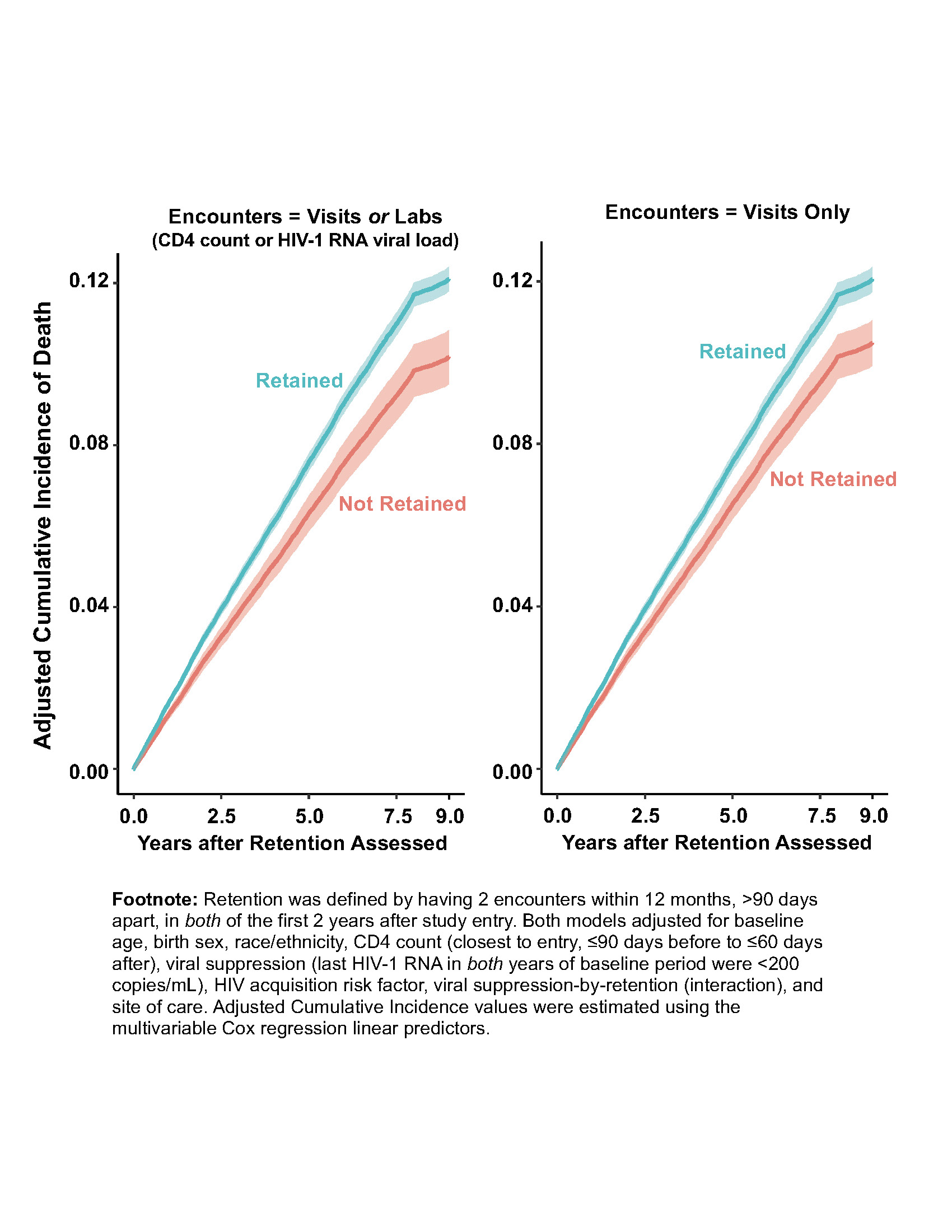
Among 95,428 PWH contributing 546,805 person-years, median baseline age was 47 (IQR: 37,55) years; 16% were female, 44% non-Hispanic Black, 35% men who have sex with men, 7% people who inject drugs, and 5-year mortality risk was 11.4%. Early retention was 74% by the visit-or-laboratory metric, and 69% by the visit-only metric. Retained PWH had higher mortality risk than those not retained under both visit-or-laboratory (HR=1.25, CI:1.16-1.36; Figure, Left) and visit-only (HR=1.17, CI:1.09-1.27; Figure, Right) metrics. Without baseline viral suppression adjustment, the retention-mortality association was null.
Conclusions
Despite known benefits of retention in HIV care, frequent interactions with HIV care in the current era may be an indicator of more clinical and non-clinical needs. In order for retention to remain a meaningful target for monitoring quality HIV care, retention metrics should be re-operationalized to better capture patterns of engagement in care that predict key clinical outcomes.
Table or Figure