Background
Dolutegravir-based regimens (DBR) represent >92% of drugs dispensed in PEPFAR-supported programs. Monitoring emergence of and characterizing the risk factors for dolutegravir (DTG) drug resistance (DR) acquisition is a key priority to ensure the continued efficacy and durability of these regimens. We report risk factors for DTG DR identified in a large cohort of patients conducted in four PEPFAR-supported programs.
Methods
Adults on a DBR in Malawi, Ukraine, Mozambique, and Uganda whose remnant viral load (VL) samples were successfully genotyped from 2020-2022 were included in the analysis. We defined DTG DR as levels 3-5 (low, intermediate, or high) by Stanford HIV Drug Resistance Database. We fit an exact logistic regression model with DTG DR as the outcome and clinical and sociodemographic variables as covariates. SAS was used to fit the model and produce adjusted odds ratios (aOR) and 95% confidence intervals (CI).
Results
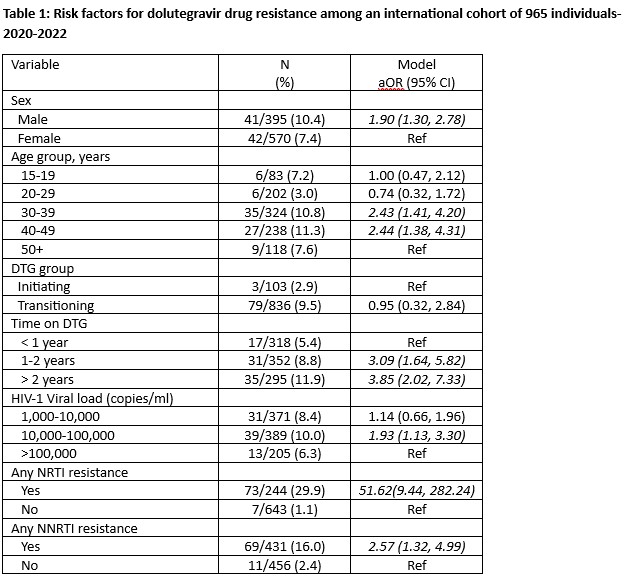
A total of 965 specimens were included; 83 had DTG DR. About 9 in 10 individuals were transitioned to DBR from another regimen. Median age was 36.2 years (95%CI 28-43), median time on a DBR was 1.5 years IQR:0.80-2.14), and nearly 60% of individuals in the cohort were female. Male sex [aOR 1.90 (95% CI 1.30, 2.78)]; age 30-39 years [aOR: 2.43 (95%CI 1.41, 4.20)] and 40 to 49 years [aOR: 2.44 (95%CI 1.38, 4.31)]; time on DTG 1-2 years [aOR: 3.09 (95%CI 1.64, 5.82)] and above 2 years [aOR: 3.85 (95%CI 2.02, 7.33)]; VL between 10,000 and 100,000 copies/ml [aOR 1.93 (95%CI 1.13, 3.30)]; any nucleoside reverse transcriptase inhibitor (NRTI) [aOR: 51.6 (95%CI 9.42, 282.2)]; or non- nucleoside reverse transcriptase inhibitor (NNRTI) resistance [aOR: 2.57 (95%CI 1.32, 4.99)] were identified as risk factors to DTG DR.
Conclusions
Conclusions: In this multicounty cohort, male sex, ages 30-49 years, VL between 10,000 and 100,000 copies/ml, time on DTG of >1 year and presence of NRTI or NNRTI DR were risk factors for DTG DR. Notably, the duration on DTG showed a dose-response effect, with longer use linked to higher DR rates. The presence of NRTI DR had a large effect that has been previously observed; although NRTI recycling in 2nd-line is supported by data, the presence of NRTI DR may make DTG more vulnerable to DR emergence. In settings where genotypic testing is not widely available, these findings could help programs develop screening algorithms to correctly identify, test and switch those with DR to an effective regimen.
Table or Figure