Background
Lenacapavir (LEN) is an FDA-approved drug for highly treatment-experienced individuals living with multidrug-resistant HIV-1 infection. LEN inhibits HIV-1 replication with sub-nanomolar potency by targeting the capsid protein (CA) at the “FG-binding pocket” (FGBP). Clinical trials report the emergence of CA mutations like M66I and N74D after LEN treatment. N74D is also selected by PF74, the first reported antiviral to bind the FGBP with sub-micromolar potency. PF74 contains three aromatic moieties, R1, R2, and R3; our structure-based studies have developed improved compounds with unique chemistry at R1 and R3.
Methods
The EC50s of FGBP-targeting compounds ZW-1260, ZW-1261, ZW-1514, ZW-1517, and ZW-1559 were determined against N74D NL4-3 HIV-1 in TZM-bl cells and compared to reported wild-type (WT) potency. X-ray crystallography solved novel structures of FGBP compounds complexed with a native WT CA (PDB: 9DTM) or with only the N74D mutation (PDB: 9DTN, 9DTO) and these were compared to reported WT or N74D structures (PDB: 4XFZ, 7M9F, 7MKC). Thermal shift assays, analyzed with TSAR, determined the melting temperature (Tm) and biolayer interferometry determined binding kinetics to disulfide-stabilized CA hexamers (CAHEX). Transmission electron microscopy and in vitro assembly assays determine the compounds’ effects on WT or N74D CA lattice.
Results
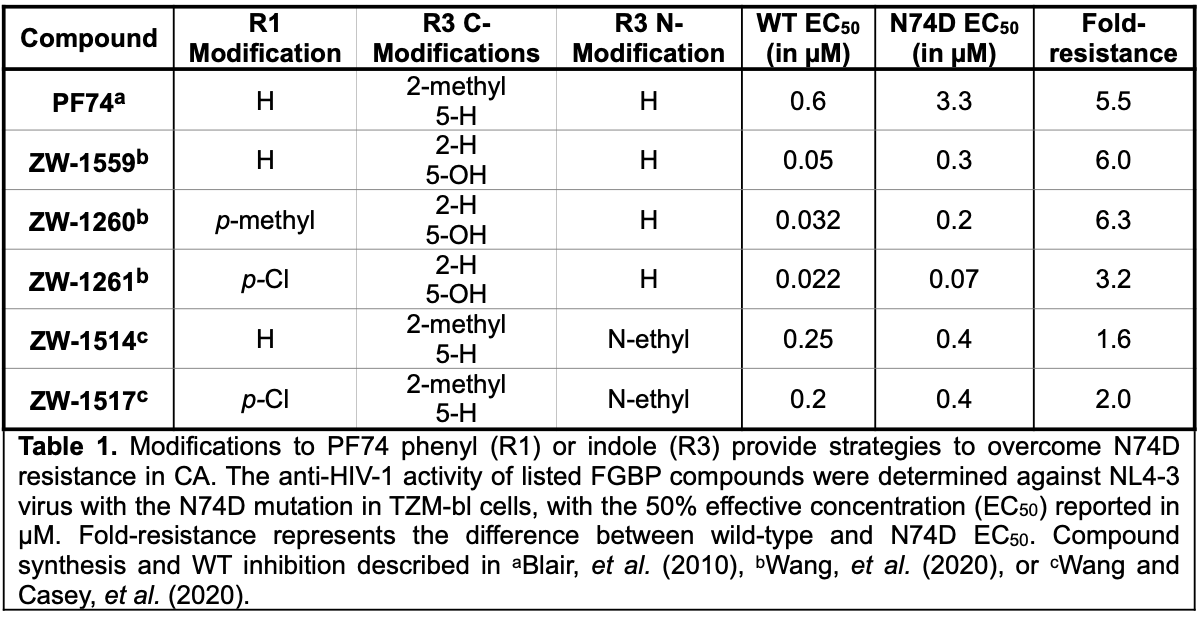
While N74D virus caused 6-fold PF74 resistance, modifications at R1 and R3 improved inhibition (Table 1). Compounds with a para-Cl on R1 and/or N-ethyl on R3 decreased N74D resistance; the R1 p-Cl of ZW-1261 interacts with N74 while R3 N-ethyl of ZW-1514 interacts with Q67. Additional interactions between modified R1 and/or R3 with CAHEX increase the Tm for both WT and N74D CAHEX, more so than PF74. CA rapidly polymerized in vitro, even in the absence of salt, after the addition of compounds with R3 C5-OH modifications, likely due to a H-bonding network involving the modified indole and the adjacent CA monomer of CAHEX.
Conclusions
Understanding the interactions responsible for increased potency and decreased resistance is essential for improved drug design. We report modifying R1 and R3 of PF74 as distinct strategies to overcome N74D resistance. One modification, R3 C5-OH, forms intermolecular interactions within and between CA subunits, which, unlike PF74, enables rapid lattice assembly in vitro. Overall, these data provide a structure-guided approach to improve antiviral activity and the resistance profile of FGBP-targeting compounds.
Table or Figure