Background
Long-acting cabotegravir and rilpivirine combination (CAB-RPV LA) is approved for HIV treatment in adults. However, individuals who become pregnant might prefer to discontinue it due to lack of definitive data on safety. The aim of this study was to estimate fetal exposure to CAB-RPV LA and time to subtherapeutic plasma level if discontinued early in pregnancy.
Methods
Adult and pregnancy physiologically based pharmacokinetic (PBPK) models were used which had been previously validated for the disposition of LA CAB and LA RPV including tail-phase PK data from published studies. Approved monthly adult dosing of LA CAB-RPV was initiated in a virtual population of non-pregnant women until steady state. We simulated discontinuation at steady state after only one injection during pregnancy. Fetal exposure to both drugs in the second and third trimesters was estimated. Tail-phase PK of CAB and RPV from LA injections was characterised during gestation and until 6 months postpartum.
Results
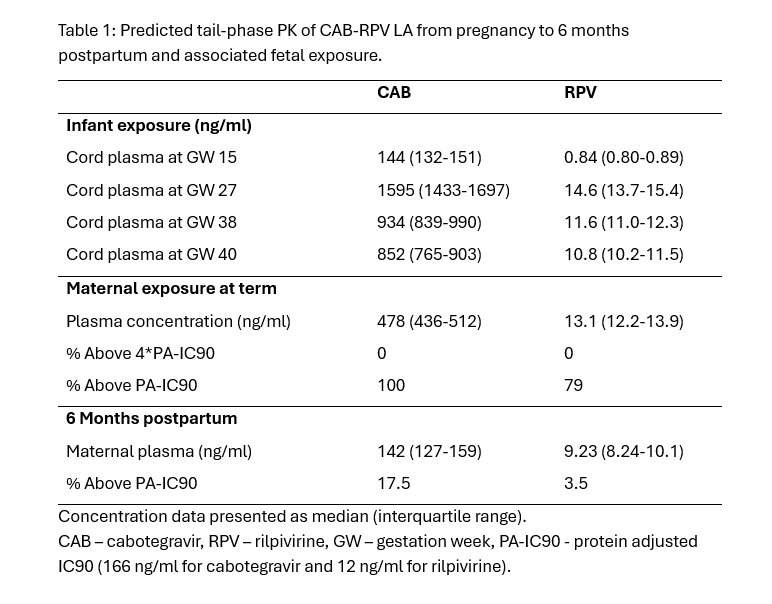
A total of 8 scenarios were simulated (n = 100 each) in virtual populations of non-pregnant, pregnant and postpartum women. Mean (SD) age was 27 (5) yrs and body weight was 58 (13) kg. PK tail was driven by residual drug in muscle depot and was predicted to stabilise at steady state. Predicted median (IQR) maternal plasma concentration was 478 (436-512) ng/ml for LA CAB and 13.1 (12.2-13.9) ng/ml for LA RPV at delivery, and below their respective 4x protein adjusted IC90 (PA-IC90) in 100% of simulated cases (Table 1). This was above the PA-IC90 in 100% of women at delivery for CAB LA and 79% for RPV LA. Fetal exposure based on predicted median (IQR) cord plasma level was highest during week 22 for LA CAB at 1864 (1678-1987) ng/ml and during week 28 for LA RPV at 14.6 (13.8-15.4) ng/ml. CAB and RPV were predicted to remain detectable in maternal plasma 6 months postpartum at 142 (127-159) ng/ml and 9.23 (8.24-10.1) ng/ml, respectively. Also, 17.5 and 3.5% of the women were predicted to have CAB and RPV plasma concentrations above their corresponding PA-IC90, respectively, at 6 months postpartum.
Conclusions
The PK tails of CAB-RPV LA extend to several months postpartum, with levels falling below established minimum effective concentration in most women after gestation week 33. Potential strategies to minimise potential risks associated with CAB-RPV LA discontinuation in this population are needed. Breastfed infant exposure was not investigated in this study.
Table or Figure