Background
The LN factors regulating HIV reservoir maintenance, particularly in antiretroviral treated people living with HIV (cART PLWH), are not defined. Presumably, the interplay between innate (e.g. monocytes, dendritic cells) and adaptive immune cells, particularly TFH cells, a main HIV reservoir component, is critical for this maintenance. We have applied complementary methodologies to delineate the LN landscaping and search for possible associations between in situ factors and HIV viral DNA content.
Methods
LN tissue sections from viremic (n=12) and cART (n=9) PLWH were analyzed by multiplex immunofluorescence imaging (7- and 12-plex panels) and spatial transcriptomic (GeoMx) methodologies while LN-derived cells were investigated by multiparametric flow cytometry and scRNA-10X. The blood HIV DNA content was measured by the Rainbow platform that quantifies intact HIV DNA. Computational tools (Histocytometry, R and python algorithms) were used for data analysis.
Results
Our imaging analysis revealed that i) contrary to viremic LNs, no association was found between TFH cell prevalence and HIV DNA in cART LNs, ii) the cell densities of follicular and extrafollicular total and GrzB+CD8T cells were negatively associated with HIV DNA, both in viremic and cART LNs, iii) follicular and extrafollicular prevalence of IL10+cells (similar contribution by CD163hiCD68lo and CD163loCD68hi cells) were positively associated with HIV DNA and v) follicular and extrafollicular prevalence of IFNb+ cells (higher contribution by CD163loCD68hi) were negatively associated with HIV DNA, suggesting a negative role for HIV persistence. Flow cytometry analysis of single cell suspensions showed a similar phenotypic clustering profile (relative expression of cell subsets) of Tregs cells among the donors regardless of their HIV DNA. The in situ transcriptomic analysis showed a significant overexpression of genes associated with Bile Acid metabolism and induced signaling in cART vs viremic follicles/LNs.
Conclusions
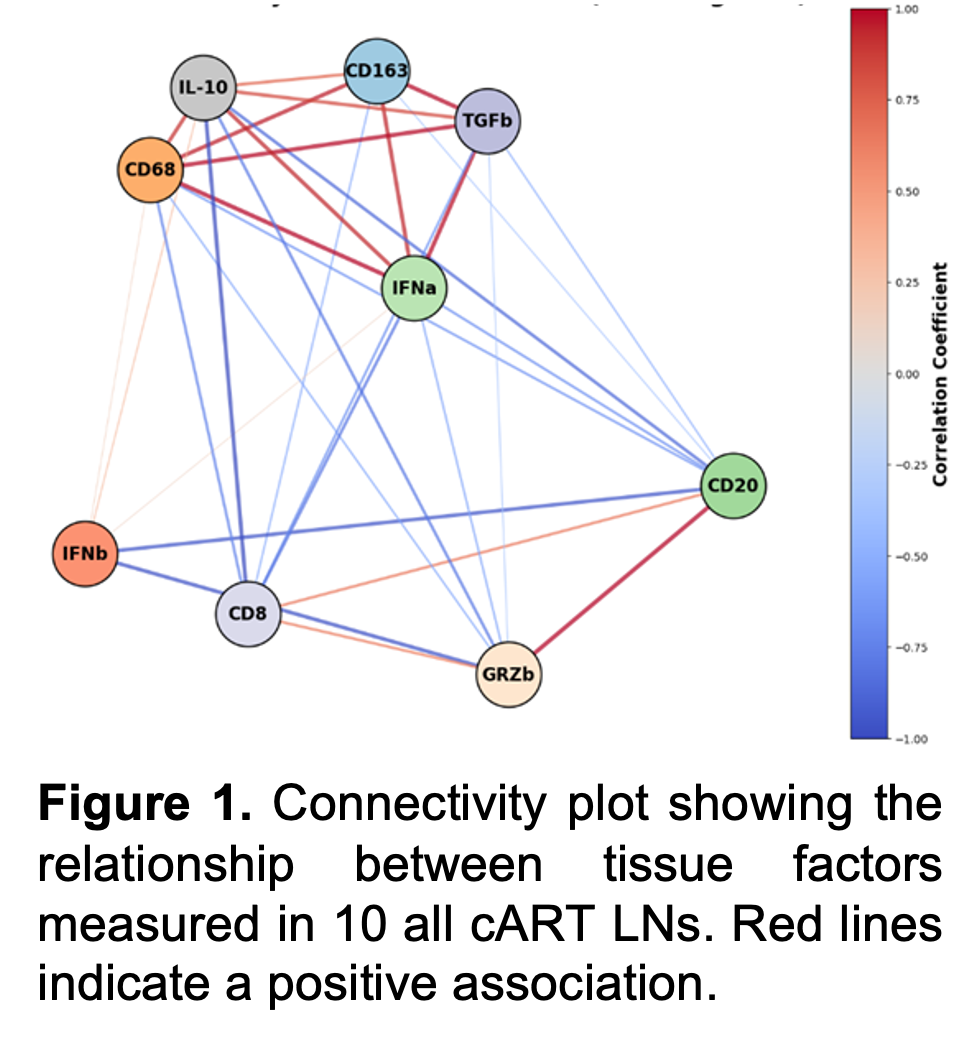
We provide a multilevel assessment of PLWH LN immune dynamics, particularly in follicular/germinal center areas. The data point to a network of soluble factors produced by innate immunity cells and Tregs (TGFb, IL10 and IFNb) (Figure 1) as potential mediators for viral reservoir regulation. Furthermore, Bile Acids that can trigger the production of TGFb and Interferons (shown by members of RID HIV) could represent a crucial triggering factor for the aforementioned network.
Table or Figure