Background
The Ward 86 HIV Clinic in San Francisco serves publicly-insured people with HIV (PWH) living with multiple concomitant challenges. With the approval of long-acting (LA) cabotegravir/rilpivirine in 2021, Ward 86 started using LA antiretroviral therapy (ART) for those with adherence challenges to oral ART. More than 3.5 years into the program, we now report on and compare the long-term virologic suppression (VS) rates in those who started LA ART with or without initial VS.
Methods
Using electronic medical record data verified by clinician review, we compared outcomes in the Special Programs to Stop HIV Using Long-Acting ART (SPLASH) program for those starting LA ART with or without VS. For those starting with initial viremia, the time to VS was calculated by Kaplan-Meier. Chi-squared testing compared VS and logistic regression compared characteristics between those starting LA ART with and without viremia.
Results
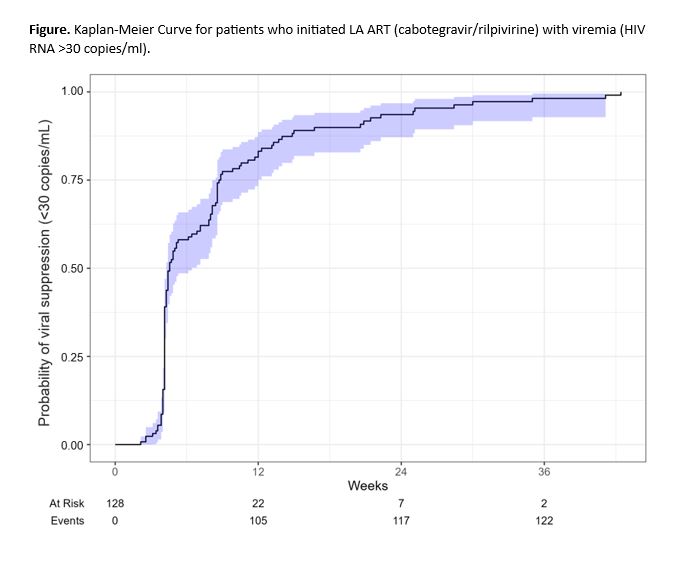
Overall, 370 participants (mean=46.3 years, SD = 11.6) starting LA ART from January 2021-September 2024 were included in the analyses; 80% cisgender male, 14% cis/transgender female, 6% non-binary/ other; 41% White, 28% Latino/a, 23% Black, 8% Asian; 40% housing instability; 46% substance use. Among the 130 PWH (35%) starting LA ART with HIV RNA >30 copies/mL, the rates of current or past substance use (OR = 1.22, 95% CI 1.11-1.34, p < .001) and unstable housing (OR = 1.11, 95% CI 1.01-1.23, p = .031) were higher than in those with initial VS. PWH with viremia were more likely to have CD4 counts <200 cells/mm3 (OR = 1.22, 95% CI 1.09-1.36, p < .001) at initiation. The median time to achieve VS (<=30 copies/ml) in those with viremia was 32 days (95% CI 30-45; Figure). At 24 weeks, 98.3% of those who started with VS remained suppressed and 94.5% of those with initial viremia achieved VS. The probability of achieving/maintaining VS did not significantly differ between the two groups at 24 weeks (χ² 3.12, p = .077).
Conclusions
In a cohort of PWH in San Francisco with high rates of housing instability and substance use, LA ART worked well with high rates of VS either maintained (98.3%) in those initiating ART with VS or achieved (94.5%) in those starting with viremia. CD4 counts were lower in those with initial viremia. There was no difference in the probability of VS at 24 weeks among those who started LA ART with and without VS. This data supports the DHHS and IAS-USA guidelines on using LA ART in those with viremia and adherence challenges at high risk of HIV progression.
Table or Figure