Background
Although sustained virologic response (SVR) following direct-acting antiviral (DAA) therapy is a key goal in treating hepatitis C, some patients continue to experience liver disease progression despite HCV clearance. Metabolic dysfunction-associated steatotic liver disease (MASLD) may contribute to this progression. This study aims to characterize the lipidomic profiles linked to MASLD in HIV/HCV-coinfected patients with advanced fibrosis or cirrhosis at 1 and 6 years (yrs) after DAA-induced SVR.
Methods
Fifty-two HIV/HCV-coinfected patients with advanced fibrosis or cirrhosis who achieved SVR following DAA therapy were included. Untargeted lipidomic profiling was performed on plasma samples collected at 1 yr (n=52) and 6 yrs (n=29) post-SVR using liquid chromatography-mass spectrometry. The primary outcome was MASLD, defined by a Hepatic Steatosis Index ≥36 and the presence of at least one adult cardiometabolic risk factor. Statistical analyses included orthogonal partial least squares discriminant analysis (oPLS-DA) and generalized linear models (GLM), with corrections for multiple comparisons.
Results
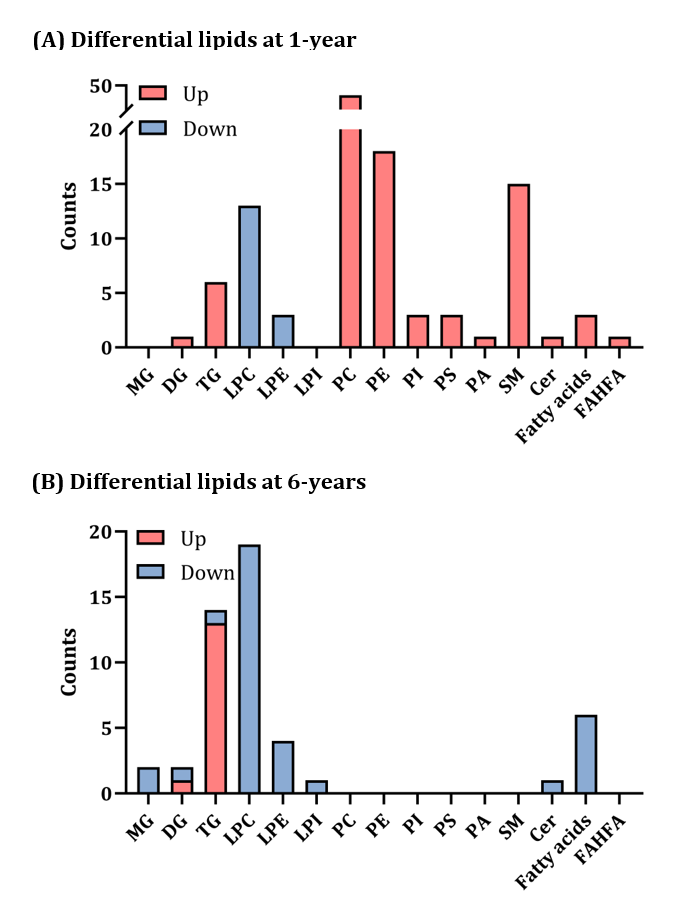
MASLD prevalence was 28.9% at 1 yr and 44.8% at 6 yrs post-SVR. oPLS-DA models showed that lipid profiles successfully differentiated patients based on MASLD status, identifying 225 plasma lipids at 1 yr and 167 at 6 yrs, with a variable importance in projection (VIP) score ≥1. Adjusted GLMs confirmed significant associations between MASLD and 116 lipids at 1 yr and 49 at 6 yrs. At 1 yr, over 75% of significant lipids were glycerophospholipids (GP), with increased phosphatidylcholines (PC) and phosphatidylethanolamines (PE) and decreased lysophosphatidylcholines (LPC) and lysophosphatidylethanolamines (LPE) in MASLD patients. By 6 yrs, LPC remained the most abundant differential lipid within the GP category. Additionally, LPE, lysophosphatidylinositols, and fatty acids decreased, while triglycerides significantly increased at 6 yrs.
Conclusions
MASLD was common during follow-up in this cohort, with lipidomic profiles indicating significant changes over time. Increases in PCs and triglycerides, alongside decreases in LPCs and LPEs, suggest ongoing metabolic disturbances that may contribute to liver disease progression despite SVR. These findings highlight the potential role of lipid dysregulation in the pathogenesis of post-SVR liver disease, emphasizing the need for long-term metabolic and liver health monitoring in HIV/HCV-coinfected patients with advanced fibrosis or cirrhosis.
Table or Figure