Background
Antiretroviral (ARV) guidelines (WHO, DHHS, IAS-USA, EACS, BHIVA) suggest HIV viral load (VL) monitoring every 3 to 6 months. No trial has evaluated intervals >6 months. There are few recommendations regarding the interval between patient assessments. During the COVID lockdown, clinical assessment and VL monitoring were less frequent in the Chelsea-Westminster (C-W) HIV cohort (3 London clinics, 5 regional clinics) and more clinical assessments were by phone. The primary aim of this analysis was to see if this less intensive HIV care during the COVID pandemic resulted in more virological failure (VF) than pre or post-pandemic.
Methods
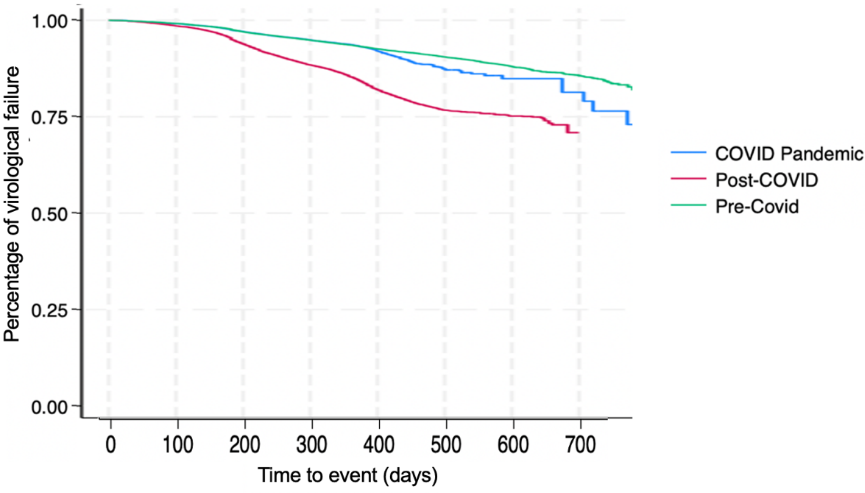
We compared VF rates (VL>200 cp/mL after VL<50 cp/mL) in three periods: pre-COVID (Jan 2018-March 2020, 26 months), COVID pandemic (April 2020-December 2021, 21 months) and post-pandemic (Jan 2022-October 2023, 22 months) in the C-W cohort, which prospectively records patient assessments and VLs. Survival analysis compared times to VF between periods, and Cox proportional hazards model to examine the impact of covariates (sex, age, born in UK, clinic area, ARV anchor class) on time to VF.
Results
14,897 adults (mean 47.0 yrs, 14.2% female, 39.6% UK-born, 87% HIV RNA <50 cp/mL) were included. The most common ARVs were TDF, FTC and an integrase inhibitor (INSTI). Mean intervals between VL tests were 30.8 weeks pre-COVID, 39.6 weeks during the pandemic and 27.9 weeks post-pandemic. The mean intervals between clinical assessments were 25.4, 32.5 and 23.8 weeks, respectively. Time to VF in the COVID period was similar to the pre-COVID period (OR 0.98, p>0.2) and longer than in the post-COVID period (OR 1.073, p=0.001; Figure 1). Clinical factors independently associated with VF in the pre-COVID period included CD4 count >600 (OR 0.51, p<0.001) and UK-born (OR 0.86, p=0.042), in the pandemic period were male (OR 0.66, p<0.001), age >45 (OR 2.14, p<0.001) and in the post-pandemic period were male (OR 0.61, p<0.001), age >45 (OR 1.52, p<0.001), care in London (OR 1.11, p=0.02) and face to face consultation (OR 0.15, p<0.001). For anchor class, the greatest risk of VF in all three periods was with a non-nucleoside reverse transcriptase inhibitor.
Conclusions
In this population, less frequent VL monitoring and less frequent clinical assessment during the COVID pandemic were not associated with more VF. Less frequent VL monitoring and less frequent clinical assessment (provided they are face-to-face) may be possible for those with undetectable viral loads.
Table or Figure