Background
Cardiac-related complications were one of the most common causes of death in youth living with perinatally-acquired HIV (YPHIV) prior to widespread ART. However, diagnosing Left Ventricular Hypertrophy (LVH) typically relies on indices based on allometric exponents estimated from adults, which normalize Left Ventricular Mass (LVM) by body surface area (BSA) or height (HT) raised to a power (BSA: 1.35, HT: 2.70). In pediatric populations and particularly among YPHIV, additional adjustment for lean and adipose body mass (LBM, ABM) may provide more accurate diagnoses.
Methods
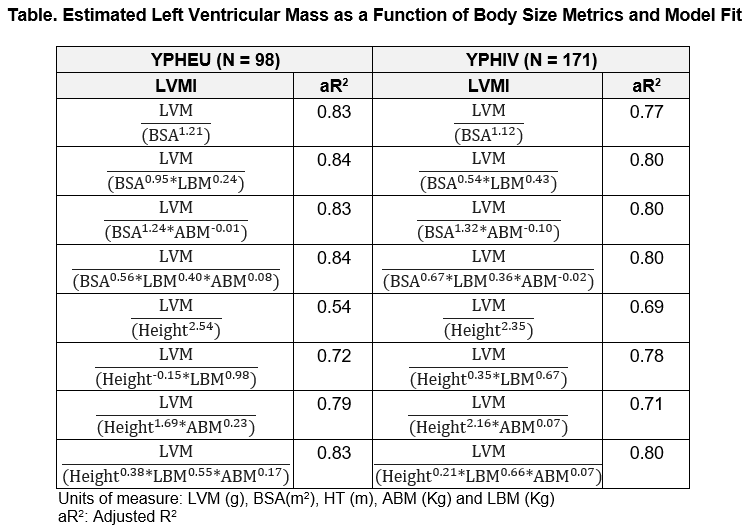
We evaluated youth (mean age 12.2, range 7.0-18.7 years, 72% nonwhite, 48% male) from the Adolescent Master Protocol (AMP) conducted by the Pediatric HIV/AIDS Cohort Study network. LVM was normalized by BSA or HT, exponentiated to values estimated from both adults and AMP cohorts (via linear regression), and assessing improvement of normalizations including LBM and/or ABM. Normalizations for LVM were computed for YPHIV and youth perinatally exposed but uninfected (YPHEU). Adjusted R2 (aR2) was used to assess the variation in LVM accounted for by BSA, HT, ABM and/or LBM. Plots of LVM indices by ABM percentage of body mass were used for visual assessments of index suitability.
Results
We included 269 AMP youth (171 YPHIV, 98 YPHEU). For LVM indices with BSA or HT alone, estimated exponents among YPHIV for BSA (1.12 (95% CI: 1.03, 1.21) and HT (2.35 (95% CI: 2.11, 2.59) were lower than those among YPHEU [BSA: 1.21 (95% CI: 1.10, 1.32), HT: 2.54 (95% CI: 2.07, 3.00)], and both were lower than standards for adult populations. In HT-based indices, including LBM made major improvements and including ABM further improved normalizations (aR2 increased 0.11-0.29) for both YPHIV and YPHEU. Mild improvements (aR2 increased 0.01-0.03) were made in BSA-based indices (Table). YPHEU BSA-based and YPHIV indices exhibited no clear patterns. YPHEU HT-based indices without ABM demonstrated a positive linear relationship with ABM%, which disappeared after ABM adjustment.
Conclusions
Better fit LVM indices for YPHEU and YPHIV populations were higher than the index based on adults, indicating that adult standards may be over sensitive for LVH diagnoses for YPHEU and YPHIV populations. Adjusting LVM for lean and adipose body mass, in addition to HT or BSA, may provide more accurate LVH diagnoses for pediatric YPHIV and YPHEU. Allometric normalizations including LBM and ABM may not be robust to proportion of adipose in whole body mass.
Table or Figure