Background
The Centers for Disease Control and Prevention (CDC) recommends routine HIV screening of persons aged 13-64 years and additional testing for those with exposure risk or symptoms. All positive HIV antigen/antibody (Ag/Ab) immunoassay results should be confirmed with HIV antibody differentiation and HIV RNA testing to resolve conflicting results. Understanding the performance and efficiency of HIV Ag/Ab testing in real-world settings is essential for guiding public health strategies and improving protocols for HIV diagnosis. We evaluated the performance of HIV Ag/Ab testing using data from a major commercial lab in the United States.
Methods
We analyzed HIV testing data from individuals ≥ 13 years tested by Quest Diagnostics between 2019 to 2023 with complete CDC-recommended algorithm testing for a positive Ag/Ab test. We calculated the testing volume and the positive predictive values (PPV) by age group and sex. PPV were calculated as the proportion of HIV Ag/Ab tests with a positive result confirmed by the CDC recommended HIV algorithm among all Ag/Ab tests with an initial positive result.
Results
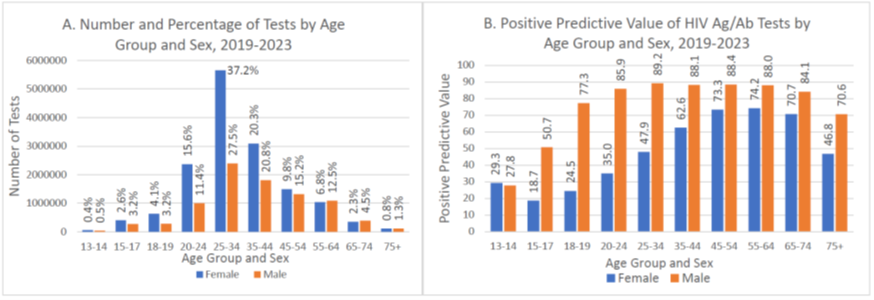
We identified a total of 23,944,766 HIV Ag/Ab tests. Of these, 36.5% were performed on men and 63.5% on women, with the majority (80.0%) among individuals aged 20-54 years. Overall, the PPV of the HIV Ag/Ab test was 78.6%. The PPV was higher in men (87.5%) than in women (58.4%). For men, PPV was lowest among those aged 13−14 years (27.8%) and peaked at 89.2% for those aged 25−34 years. PPV was > 80% for men aged 20−74 years and 70.6% for men 75+. PPV was 49.7% for women of reproductive age (15-44) and increased to 74.2% for women aged 55−64 years. Except for persons aged 13−14 years, PPV was consistently lower for women compared with men.
Conclusions
This analysis found relatively higher PPV among groups most likely to be tested by providers based on clinical or risk-based needs: men, persons reporting HIV exposure risk, persons initiating or continuing PrEP, and symptomatic individuals. Lower PPVs were observed among women of reproductive age, likely due to near-universal screening among pregnant women who have a low overall prevalence of HIV. The reported PPV of the Ag/Ab test highlights the need to conduct the entire recommended HIV diagnostic algorithm to confirm an HIV diagnosis. Understanding the performance of HIV Ag/Ab test results for specific populations may also facilitate test interpretation and recommendations for future HIV testing.
Table or Figure