Background
PD1 antagonists are on the forefront of HIV curative strategies, but systemic treatment doses have led to limiting autoimmune toxicities. As such, there is interest in using subcutaneous low-dose delivery, but data are lacking. We recently completed a trial to evaluate low dose (10 mg or ~1.4 mg/kg) intra-lesional nivolumab in 6 males with HIV on ART and 6 HIV- males for cutaneious Kaposi sarcoma (KS) and demonstrated that the drug was safe without major adverse effects or autoimmune complications. Treatment also led to partial remission in 2 participants without HIV. Here, we studied the longitudinal impact of intra-lesional nivolumab on systemic PD-1 expression, T cell cycling, virus-specific immune responses, and HIV reservoir size.
Methods
High-dimensional spectral flow cytometry was used to assess circulating T cell phenotypes, PD1 expression/receptor occupancy, and HIV and HHV8-specific immune responses prior to nivolumab therapy, following the 2nd dose and 26 weeks after the last of a total of 4-8 injections. HIV-1 reservoirs were measured in participants with HIV.
Results
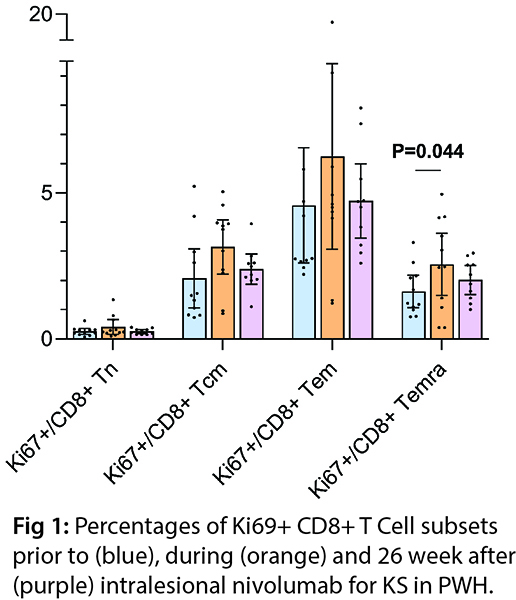
The percentage of circulating CD4+ and CD8+ T cells expressing PD-1 decreased from 23.8% and 19.2%, respectively, prior to treatment, to 10.9% and 9.4% before the third intra-lesional nivolumab injection across all participants (all P<0.05) not including nivolumab-bound cells which accounted for ~5-10% of residual PD1+ T cells while on treatment. The frequency of PD-1 expressing lymphocytes returned to baseline level 26 weeks after the last injection. A significant increase in the frequency of Ki67+ (cell cycling) terminally differential CD8+ T cells was observed from baseline to on therapy (P=0.04) and trend which was observed across all other memory CD8+ T cell subsets (Fug 1). HIV serostatus did not impact PD-1 expression or T cell proliferation. The frequency of CD4+ and CD8+ central memory and effector phenotypes also significantly increased on therapy compared to baseline (all P<0.05). No changes in HIV-1 or HHV8-specific CD4+ or CD8+ T cell frequencies or in cell-associated HIV-1 DNA or RNA were observed prior to, during and after treatment.
Conclusions
Low dose locally delivered nivolumab was safe and led to marked PD1 downregulation and increases in T cell cycling and memory expansion in participants with and without HIV while receiving treatment. Given these promising data, larger studies will be needed to assess the impact on HIV-1 persistence and virus-specific immune responses.
Table or Figure