Background
HIV-1 protease (PR) is initially synthesized as part of the Gag-Pol polyprotein precursor, which undergoes regulated autoprocessing to produce free mature PR, essential for viral particle maturation and infectivity. We previously demonstrated that precursors and mature PRs have distinct enzymatic properties, as precursors are up to 1,000-fold less-sensitive to protease inhibitors (PIs) compared to the mature PR. Thus, we established a cell-based functional assay for high-throughput screening (HTS) campaigns targeting precursor autoprocessing in the pursuit of first-in-class drug discovery.
Methods
We screened approximately 350,000 small molecule compounds at a single dose (20 µM), along with about 2,000 natural product extracts (NPEs) and subfractions (each containing 5 to 25 diverse chemicals) at ~ 2 µg/ml apparent concentrations. Positive hits were further verified using the primary HTS assay and/or an orthogonal TR-FRET assay. Additionally, we assessed several confirmed hits using a newly established highly sensitive infectivity assay to evaluate their antiretroviral activities against the WT and mutant HIV strains known to be resistant to multiple protease inhibitors (PIs).
Results
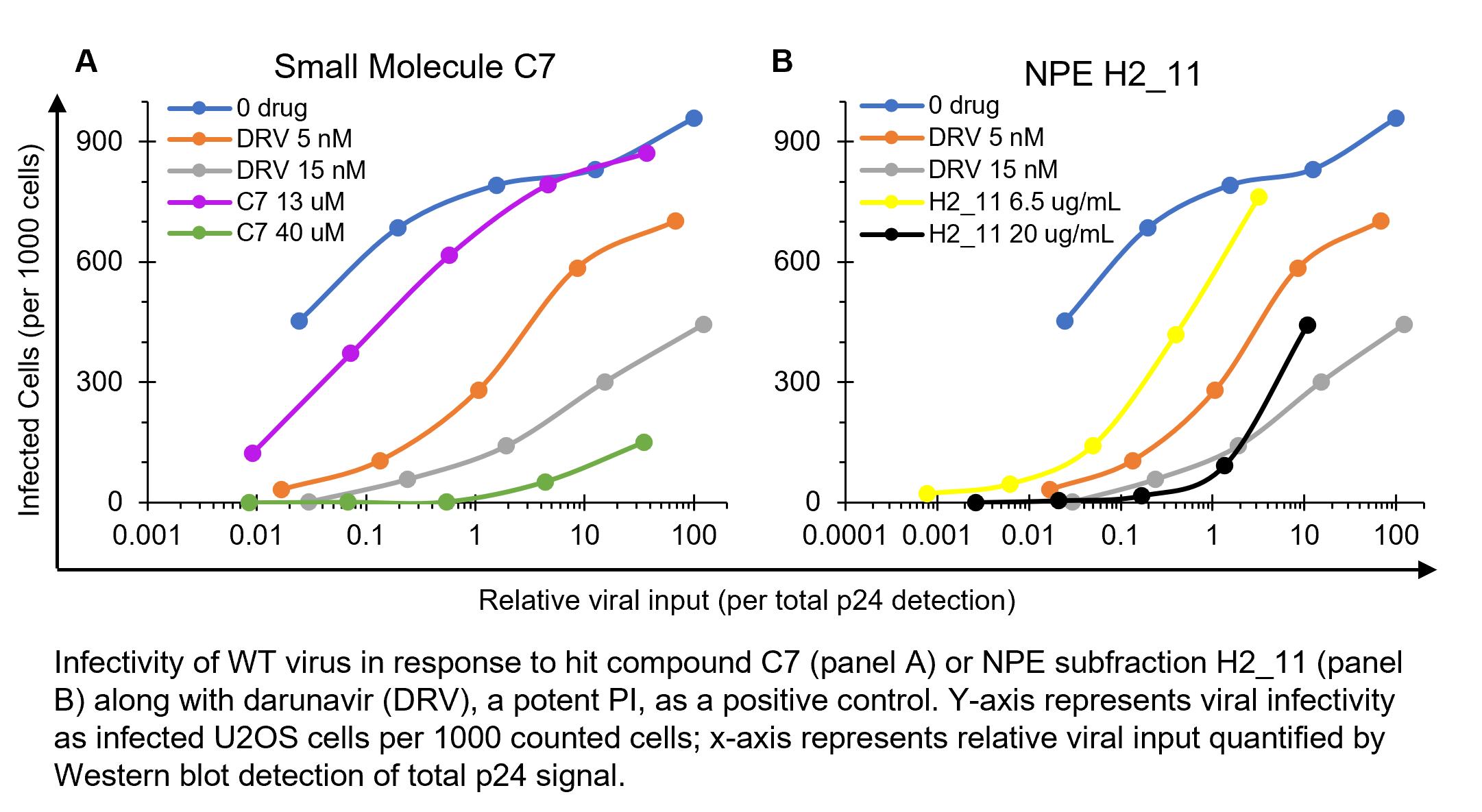
We identified several small molecule hits and NPE subfractions that exhibited partial activities in the primary HTS assay. The small molecule hits represented four scaffold groups, differing from known FDA-approved PIs. Notably, these confirmed compounds or NPE subfractions suppressed virus infectivity with single digit micromolar EC50 values. Encouragingly, the top small molecule hit (C7, attached Figure, panel A) and an NPE subfraction (H2_11, attached Figure, panel B) showed comparable potency against WT and multi-PI resistant mutants, suggesting that these hit compounds may inhibit HIV-1 PR through mechanisms different from those of current PIs.
Conclusions
This study establishes the feasibility of discovering novel autoprocessing inhibitors through HTS using a cell-based functional assay. The validated hits seemed to operate through mechanisms distinct from existing PIs, presenting a new treatment strategy for targeting a vital enzyme (HIV-1 PR) at two distinct functional states (precursor and mature PR), thereby addressing drug resistance challenges.
Table or Figure