Background
In recent years, Haiti has faced escalating civil unrest characterized by a complex mix of political crises and internal conflicts. This instability has significantly disrupted healthcare services, including HIV treatment programs, reducing the overall capacity of the healthcare system to respond effectively and exacerbating the vulnerability of already marginalized groups. Interruption in Treatment (IIT) poses a severe risk to people living with HIV (PLHIV), increasing the potential for higher HIV-related morbidity, mortality, and transmission. This analysis aimed to describe IIT trends within PEPFAR-supported HIV programs from 2022 to 2024, focusing on subnational variability, including regions heavily impacted by socio-political crises.
Methods
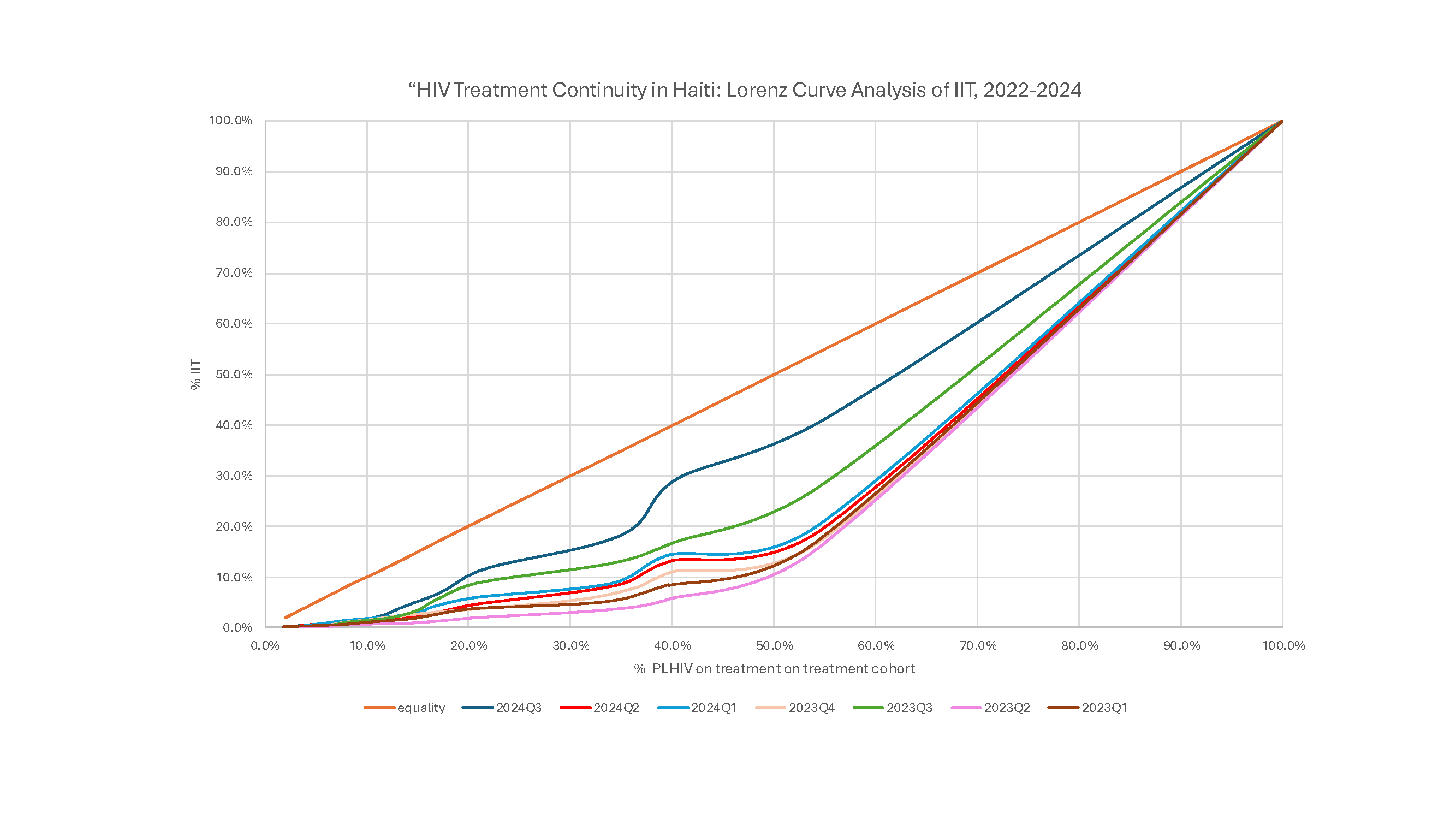
We utilized aggregated program data from reported quarterly to PEPFAR’s Panorama platform to examine IIT trends across seven quarters, from Fiscal Year (FY) 2022 Q1 to FY 2024 Q3, stratified by Subnational Units (SNUs). IIT was defined as no clinical contact or antiretroviral therapy (ART) pick-up for more than 28 days since the last expected encounter. We calculated the percentage of IIT for each quarter, stratified by Subnational Units (SNUs). Lorenz curves were used to assess inequalities in distribution of IIT relative to the cumulative number of PLHIV on ART; Gini coefficients were calculated to quantify disparities.
Results
During the study period, Haiti’s HIV treatment cohort expanded from 115,895 to 123,639 individuals. Across all SNUs, the average quarterly IIT was 2.1%, with the greatest absolute IIT occurring in FY 2024 Q2. IIT rates across SNUs varied between 0.1% and 10.9%; Lorenz curves demonstrated variability in IIT distribution, with significantly less inequality across SNUs at the end of the study period compared to the start (FY 2024 Q3 Gini coefficient = 0.18 vs. FY 2022 Q1 Gini coefficient = 0.40; Z-score 4.5, p-value <0.0001).
Conclusions
This analysis highlights disruptions in treatment continuity across SNUs in Haiti during a period of socio-political instability, with larger SNU treatment cohorts disproportionately affected by IIT. Decreasing inequality over time may suggest strategies to mitigate IIT have been successful. However, the inability to account for ‘silent migration’ between SNUs is a limitation, and further analyses are warranted. Nonetheless, these findings underscore the need to strengthen IIT preventive efforts and support for vulnerable populations.
Table or Figure