Background
Cost and implementation complexity of using HIV-1 Asanté rapid recency assays (ARRA) in routine HIV Testing Services (HTS) are previously cited concerns in scaling and sustaining HIV-1 recent infection surveillance (HRIS) in settings where workload of health care workers (HCW) remains high. We measured the additional time spent on facility-based and laboratory-based HRIS by HCW per new HIV-positive patient in Rwanda and Eswatini.
Methods
Trained data collectors used time-motion methodology to observe HCW workflows with new HIV-positive patients and recorded HCW’s time spent on HRIS-specific activities that are not conducted in parallel with routine activities at selected facilities and laboratories over 3 months. In Rwanda, HRIS is implemented as part of HIV case surveillance that takes place in HTS. For those who are diagnosed with HIV and provide consent and completes a case report form, an additional blood draw is done for ARRA at the facility or the laboratory. Results are returned to patients after viral load (VL) testing of ARRA recent samples. In Eswatini, HRIS is implemented using an opt-out approach during pre-test counseling and ARRA is run in parallel with the confirmatory HIV diagnostic test and a HRIS-specific questionnaire at the facility level. ARRA recent samples are sent to laboratories for VL testing. Results are not returned to patients. Time spent on routine HTS in Eswatini and on case surveillance activities in Rwanda for HIV-positive patients not undergoing ARRA served as controls. Data were summarized and stratified by ARRA results (recent (R) vs long-term (LT)), and implementation model (facility-based vs laboratory-based).
Results
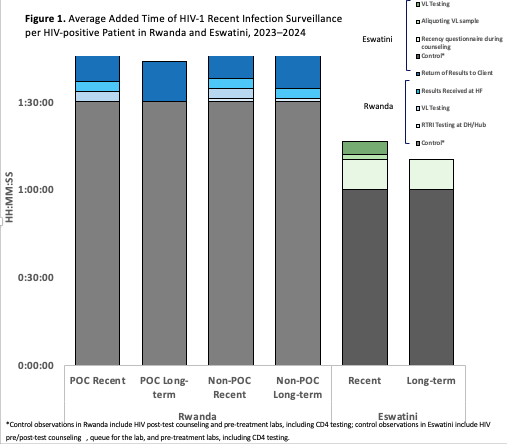
Data were collected from 84 and 76 new HIV-positive people in Rwanda (10 R, 70 LT, and 4 controls) and Eswatini (5 R, 68 LT, and 3 controls), respectively. Overall, HRIS added an average of 17 minutes to HCW duties per patient (Figure 1). In Rwanda, the average added time ranged from 13 minutes (LT) to 20 minutes (R) at facilities and from 18 minutes (LT) to 21 minutes (R) at laboratories. In Eswatini, the average added time for HRIS ranged from 10 minutes (LT) to 16 minutes (R). Return of results in Rwanda (up to 16 minutes) and HRIS-specific questionnaire (~10 minutes) in Eswatini added the most time; ARRA added no time in Eswatini and ~1 min in Rwanda.
Conclusions
ARRA is well integrated into HTS. Fully integrating HRIS into HIV case surveillance and dropping HRIS-specific questionnaires may further reduce added time.
Table or Figure