Background
Patients on PI/r-based regimens in resource-limited settings have high rates of NRTI resistance, but testing is rarely available.
Methods
In this open-label prospective trial conducted at GHESKIO in Haiti, virologically suppressed adults on second-line PI/r-based ART were randomized to continue current regimen vs. switch to B/F/TAF. The primary endpoint was the proportion with HIV-1 RNA ³200 copies/mL at week 48 using the FDA snapshot algorithm. Proviral DNA genotype testing (GenoSure Archive, Monogram Biosciences) was performed on baseline samples for all participants randomized to B/F/TAF, HIV RNA genotyping was done for participants with virologic failure (VF), and results were interpreted using IAS-USA resistance mutations (RAMs) and Stanford HIVdb version 9.6.
Results
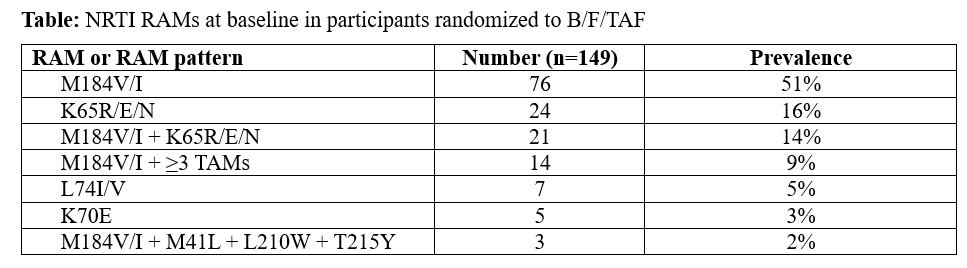
Between October 2020 and April 2023, of 436 patients screened, 301 were randomized and treated (B/F/TAF: 153; PI/r: 148); median age 48 years (IQR 40, 56) and 173 (58%) were women. At enrollment, 180 (60%) were taking LPV/r and 121 (40%) ATV/r; 234 (78%) were taking TDF, 54 (18%) AZT, and 13 (4%) ABC; all were taking lamivudine or emtricitabine. At week 48, the proportion with HIV-1 RNA ³200 copies/mL was 0.7% (1/153) and 4.1% (6/148) in the B/F/TAF and PI/r groups, respectively, 145 (95%) and 132 (89%), respectively had 48-week HIV-1 RNA <200 copies/mL. Of 153 participants randomized to B/F/TAF, 149 had baseline proviral genotype results. NRTI RAMs were common; 76 (51%) had M184V/I conferring resistance to FTC, 3TC and ABC, 24 (16%) had K65R/E/N conferring resistance to TDF, and 21 (14%) had M184V/I + K65R/E/N (Table). There were 108 (72%) with RAMs to at least one major ARV class (NRTI, NNRTI, PI or INSTI) at baseline, of which 67 (45%) had 2-class resistance and 9 (6%) had 3-class resistance. One participant on B/F/TAF met criteria for VF at Week 48; baseline and at failure genotypes had no RAMs. In the PI/r group, 3 of 4 participants who met criteria for VF at Week 48 had successful genotyping, one with NRTI and NNRTI RAMs (D67D/G, M184V, K103S, P225H) and two with NNRTI but no NRTI RAMs (K103N; V179V/D).
Conclusions
Switching virally suppressed adults with or without NRTI resistance from a second-line PI/r regimen to B/F/TAF was non-inferior to continuing a PI/r regimen. These results suggest it can be done without baseline or historical drug resistance testing in regions where INSTI resistance is uncommon.
Table or Figure