Background
CD4+ T-cell recovery varies among people with HIV (PWH) who are virologically suppressed on antiretroviral therapy (ART). Our objective was to identify the genetic predictors of CD4 recovery measured by the slope of longitudinal CD4+ T-cell counts within two years after ART initiation in PWH virologically suppressed on ART. We hypothesized that select single nucleotide polymorphisms (SNPs) would associate with CD4 slope in PWH initiating ART.
Methods
A genome-wide association study (GWAS) was performed on samples from PWH in the Million Veteran Program (MVP). HIV infection was defined by 1 inpatient or 2 outpatient HIV ICD codes, or a detectable HIV-1 plasma RNA viral load, or ART prescribed for > 31 days. Individuals had at least 2 CD4 counts: one at baseline (up to 6 months prior to ART) and others within 2 years after ART. We evaluated SNP associations with CD4 slope adjusting for age at ART initiation, sex, and 10 principal components using linear regression. After standard quality control procedures, the TOPMed-imputed SNPs were used in ancestry-specific GWAS of common variants (minor allele frequency>5%). A meta-analysis was conducted to evaluate multi-ancestry associations. We considered P-value of 5×10⁻⁸ as the genome-wide significance (GWS) threshold.
Results
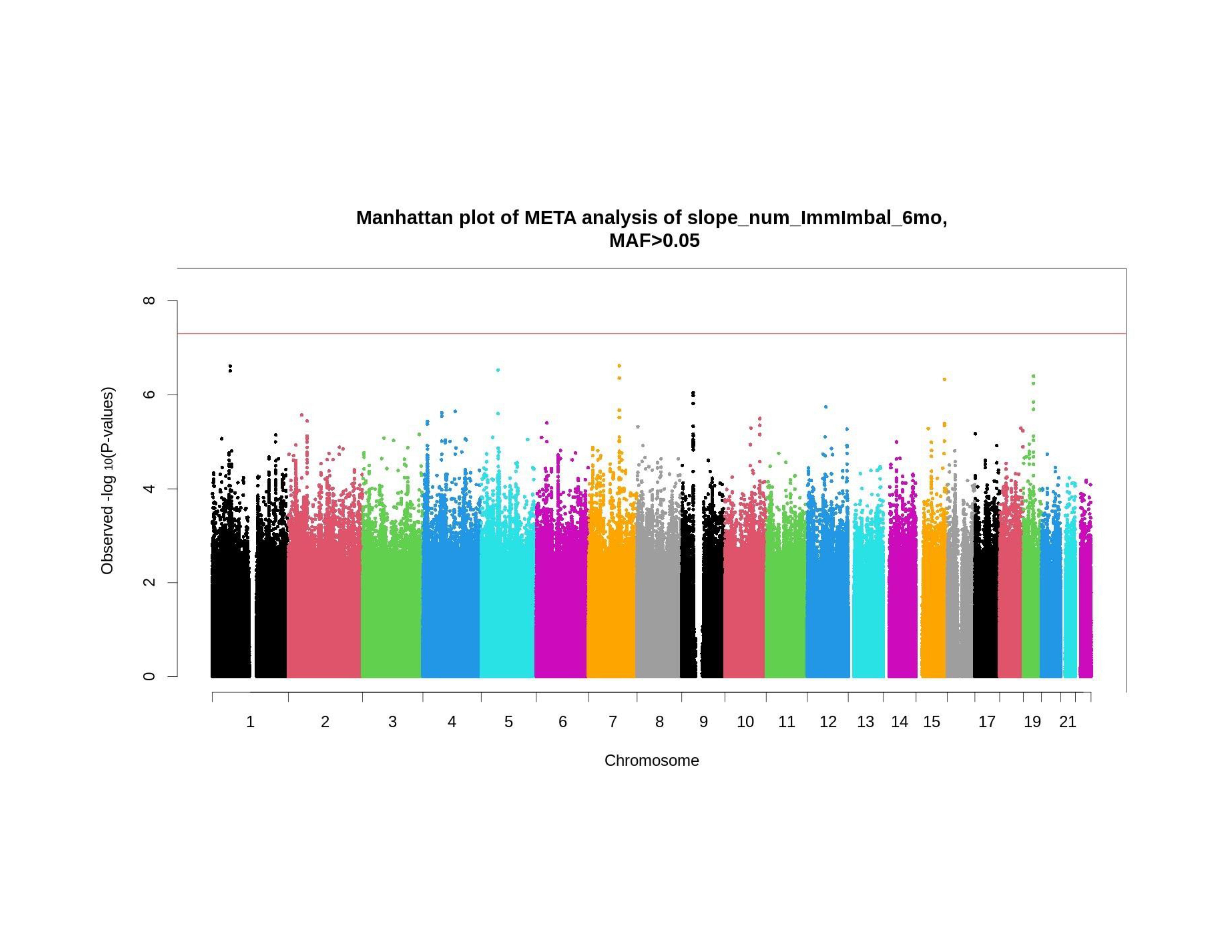
A total of 4192 PWH (48% African Americans, 97% male) were included in the GWAS. Mean age at ART initiation was 49 years and mean nadir CD4 count was 358 cells/µl. Median intercept and slope were 394 cells/µl and 0.118 cells/μL/year, respectively. Although no SNP meeting GWS was identified in the multi-ancestry GWAS of CD4 slope, three common variants were associated at P-value <1×10⁻⁶, with consistent directionality of association in all three ancestral groups: European, African and Hispanic Americans. One chromosome 7 locus, close to TRIM56 gene (rs7786422, β= -0.0456; p= 2.42 x 10⁻⁷), and one chromosome 9 locus, mapped to TOMM5 gene (rs10973430, β= -0.0532; p= 9.11 x 10⁻⁷) were associated with diminished CD4 recovery.
Conclusions
In the first study of PWH in MVP, we did not identify GWS associations with CD4+ T-cell slope after ART initiation, possibly limited by sample size. However, we found several sub-threshold genetic associations; TRIM56 has inhibitory effects on viral replication, while TOMM5 is part of a complex in mitochondrial outer membrane, acting as an entry point for viral proteins. Replication study in larger sample sizes is needed.
Table or Figure