Background
In Vietnam, national guidelines require a Tuberculosis (TB) infection test before TB preventive therapy can be administered. However, Interferon Gamma Release Assays (IGRAs) require advanced laboratories for processing, resulting in limited access. The Standard F TB-Feron fluorescent immunoassay (TB-Feron) is a simplified IGRA which requires less manual handling and no specialized laboratory staff.
Methods
This cross-sectional diagnostic accuracy study was conducted between June and August 2024 and enrolled participants in three groups: 1) people with bacteriologically-confirmed (Bac(+)) pulmonary TB; 2) household contacts (HHCs) of people with TB; and 3) people with a recent negative IGRA test and no known prior exposure to TB. At baseline visits, participants underwent clinical assessment and provided blood for the TB-Feron and QuantiFERON-TB Gold Plus (QFT-Plus) assays, with the latter serving as the TB infection reference standard. Primary endpoints included TB-Feron’s sensitivity and specificity. To evaluate secondary endpoints on inter-test agreement and intra-test reproducibility, 15 blood samples were collected and tested with a second TB-Feron assay.
Results
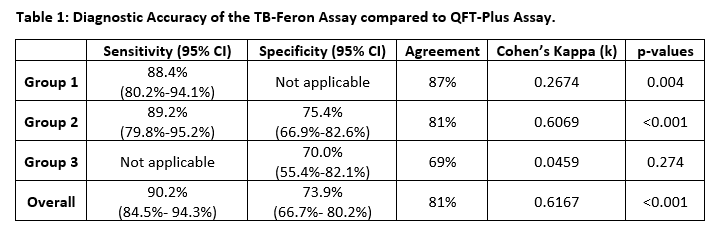
We included 345 participants in the analysis, after excluding four with indeterminate TB-Feron and/or QFT-Plus results and two from Group 3 with positive QFT-Plus results. Among the 95 individuals from Group 1 with Bac(+) TB, TB-Feron demonstrated a sensitivity of 88.4% (95% CI: 80.2-94.1). Among 200 HHCs in Group 2, TB-Feron showed a sensitivity of 89.2% (79.8-95.2) and a specificity of 75.4% (66.9-82.6). Among the 50 participants in Group 3 with no prior TB exposure, specificity was 70% (55.4-82.1). Across all groups, TB-Feron’s sensitivity and specificity were 90.2% (84.5-94.3) and 73.9% (66.7-80.2), respectively. The concordance between TB-Feron and QFT-Plus was 81% (Cohen’s κ = 0.6167; p<0.001). No systematic differences were observed between the 30 TB-Feron tests performed by two different laboratory staff (Bland Altman plot, p=0.206).
Conclusions
This study indicates that TB-Feron has high sensitivity, yet moderate specificity for diagnosing TB infection. Future studies may further evaluate the assay’s diagnostic performance, particularly among key populations, to better understand its potential as a near-point-of-care clinical tool to rapidly indicate TB preventive therapy.
Table or Figure