Background
The highly efficacious mRNA-based COVID-19 vaccines had good uptake in Washington State and Oregon with at least 75% of the population in each state receiving at least one dose. Estimating the impact of COVID-19 vaccination campaigns has been challenging given 1) the concurrent buildup of population-level immunity from infection, primary vaccination, and booster doses, 2) the spread of variants during 2021 and 2022 which evaded population immunity, and 3) the changing backdrop of non-pharmaceutical interventions as the epidemic waned. Model-based counterfactuals, which simulate the epidemic without any vaccination, can account for these factors.
Methods
To create vaccine-free counterfactual scenarios, we used a compartmental, age-structured epidemic model, with time-varying rates of transmission and vaccination. Our model incorporated 1) protections against SARS-CoV-2 infection and COVID-19 hospitalization due to vaccination and prior infections and 2) waning of those protections due to loss of immune memory and novel SARS-CoV-2 variants. We formulated and parameterized our model using a prior meta-analysis on the durability of immunity. We then reconstructed time-varying rates of transmission using the number weekly hospitalizations and infections by age and region in Washington State from January 1st, 2020 to December 31st, 2022 and Oregon from January 1st, 2020 to August 31st, 2022.
Results
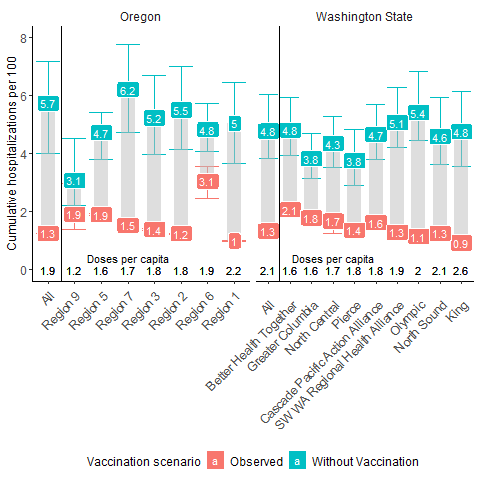
We estimate that 74.3% (95% credible interval 68.5 – 78.3) of hospitalizations were averted due to COVID-19 vaccination in Washington and Oregon through the end of 2022 (see figure for regional breakdown). During the Alpha and Delta waves vaccination averted 90.4% (87.8 – 92.6) and 87.0% (81.9 – 89.8), respectively. Booster doses averted 24.0% (11.8 – 34.0) of Omicron hospitalizations starting December 2021. To isolate the impact of vaccinating individual age groups, we calculated the number of hospitalizations averted by observed vaccination program relative to a program that excluded a given age group. Vaccinating individuals ages 18-49, 50-64 or 65+ averted 167K (116 – 215), 40K (28 – 49), or 46K (40 – 53) hospitalizations, respectively.
Conclusions
The COVID-19 vaccination campaign was highly effective, particularly during the Alpha and Delta waves. Despite limited uptake, booster doses also averted a significant number of hospitalizations during the Omicron Wave. Due to indirect effects, vaccinating adults ages 18-49 proved to be just as important at vaccinating individuals 50 years or older.
Table or Figure