Background
Medication-assisted treatment (MAT) with buprenorphine/naloxone (BUP) or methadone (MET) is an effective harm reduction strategy for people with opioid use disorder. Whether there is a benefit of one over the other on cardiovascular disease (CVD) risk is unknown and is especially important for people with HIV (PWH) where we have shown that use of illicit fentanyl/heroin results in heightened vascular inflammation.
Methods
People with and without HIV initiating MAT were enrolled in a 48-week prospective cohort study. Measures of endothelial function (reactive hyperemic index [RHI]) and arterial elasticity (augmentation index standardized at 75 beats per minute [AI] and pulse wave velocity [PWV]) were assessed at entry, week 12, 24, and 48. Constrained longitudinal mixed models with random intercept were used to assess changes in these outcomes. Adjusted models included age at baseline, sex, race, and time-on-MAT.
Results
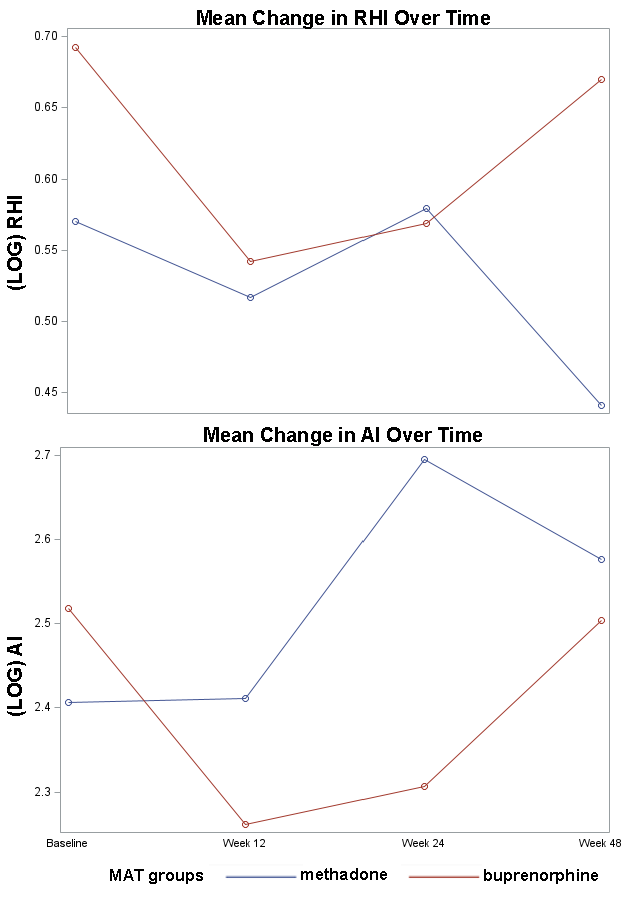
82 participants (28 MET; 54 BUP) were enrolled. Overall, median (IQR) age was 39 (33, 52) years; 33% were female; 62% were White not Hispanic, 15% were Black not Hispanic, and 21% were Hispanic regardless of race. 21 (26%) participants had HIV; entry current and nadir CD4 counts were 651 and 271 cells/mm3 and 78% had HIV-1 RNA <200 copies/ml. PWH were more likely to receive BUP. Entry median (IQR) RHI was 2 (1.5, 2.5), AI was 9% (-4, 31), and PWV was 6.8 (6.1, 7.9) m/s without differences between groups. Overall, 33% had abnormal RHI (<=1.67) at entry. In adjusted models, at 48 weeks, the marginal mean difference in RHI decreased from 1.8 to 1.6 [D -0.2 (95% CI: -0.2, 0.6)] among MET treated and nominally increased from 2.09 to 2.1 [D 0.01 (95% CI: -0.3, 0.3)] among BUP treated [adjusted mean difference at 48 weeks MET vs BUP = -0.48 (95% CI: -0.88, -0.08; P=0.03)]. There were no differences in change in AI or PWV over 48 weeks between groups.
Conclusions
While measures of arterial stiffness did not differ by MAT used, endothelial function as measured by RHI was better in participants treated with BUP than MET. Medications that bind opioid receptors including MAT have immunomodulatory potential which could alter downstream CVD risk. Buprenorphine based MAT may be a better choice for PWH given heightened CVD risk in this population.
Table or Figure