Background
Reducing HIV-related disparities is one of the four goals of the National HIV/AIDS Strategy. The Ending the HIV Epidemic (EHE) initiative, a key component of the Strategy, focuses on scaling up prevention and treatment services in priority jurisdictions. It is unclear what effect the EHE initiative may have on racial and ethnic health disparities related to HIV.
Methods
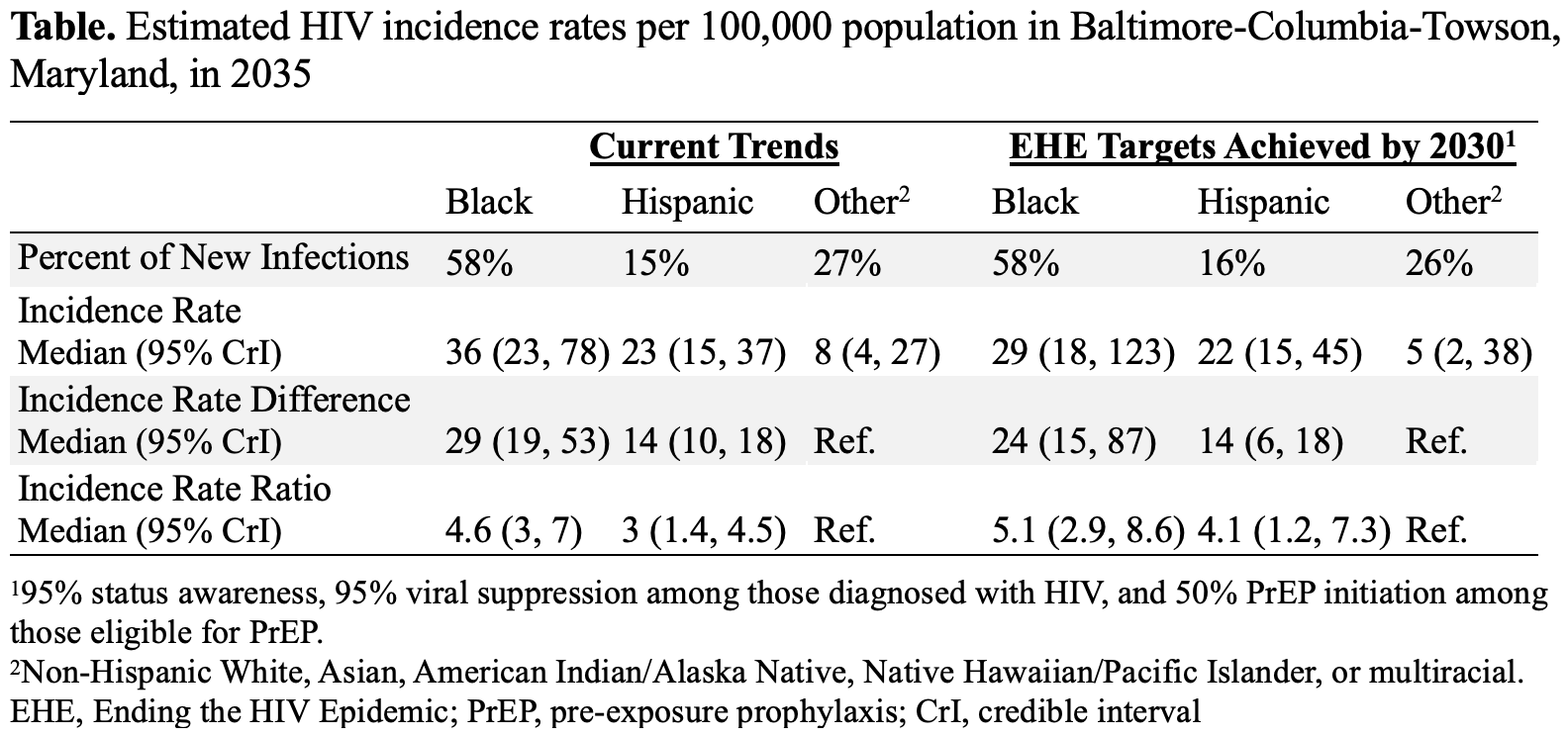
We used the Johns Hopkins Epidemiological and Economic Model, a dynamic compartmental model of HIV transmission in US cities, to project HIV incidence in 2035 in Baltimore, MD. The model is stratified by age, sex, transmission risk factor, and race/ethnicity: non-Hispanic Black (representing 75.5% of prevalent HIV diagnoses in Baltimore in 2022), Hispanic (5.5%), and other racial/ethnic groups – predominantly non-Hispanic White (12.5%). We calibrated the model to local surveillance data. We estimated the impact of increasing testing, viral suppression, and pre-exposure prophylaxis (PrEP) uptake, starting in 2025, to achieve EHE target levels by 2030: 95% status awareness, 95% viral suppression among those diagnosed with HIV, and 50% PrEP initiation among those eligible for PrEP. The intervention was race-neutral: testing rates were scaled by the same factor in each model stratum, as were the proportion unsuppressed and proportion not on PrEP. We report HIV incidence rates, differences, and ratios comparing Black and Hispanic vs. other racial/ethnic groups, with 95% credible intervals (CrI) from 100 independent model simulations.
Results
Under current epidemic trends and in the absence of additional intervention, we predicted the overall HIV incidence rate to fall only slightly from 19 incident HIV infections per 100,000 population in 2025 to 18 in 2035. Achieving target levels of testing, viral suppression, and PrEP by 2030 was projected to reduce incidence in 2035 by 22%, to 14 per 100,000 (95% CrI: 9, 64). Racial and ethnic disparities in HIV incidence persisted under the intervention compared to current epidemic trends (Table). Specifically, even with this intervention, HIV incidence remained 5 times as high among Black individuals and 4 times as high among Hispanic individuals compared to other racial/ethnic groups in Baltimore.
Conclusions
The EHE initiative alone is unlikely to significantly reduce existing racial and ethnic disparities in HIV incidence in Baltimore. More targeted interventions are likely needed to ameliorate entrenched HIV-related health disparities in high-burden cities across the United States.
Table or Figure