Background
Little is known about glucose regulation by insulin in early pregnancy in women with HIV (WWH) receiving tenofovir/lamivudine/dolutegravir (TLD). We assessed differences in insulin dynamics in early pregnancy in WWH receiving TLD.
Methods
The ORCHID study enrolled WWH initiating/receiving TLD and HIV-seronegative (HIV-) women >16 years old and <18 weeks gestational age (GA) in South Africa. Pregnant women known to have diabetes or hypertension were excluded. For this analysis we included women who enrolled at <14 weeks GA. Participants underwent a 75g oral glucose tolerance test (OGTT) to estimate insulin sensitivity (Matsuda index), 1st phase insulin response (Stumvoll equation), beta-cell function (oral disposition index, DIo), and Mari model-derived measures of beta-cell function (glucose sensitivity) and postprandial insulin clearance. TLD duration was categorized as <15 (TLD<15) vs 15-90 (TLD15-90) vs >90 (TLD>90) days prior to enrollment. Quantile regression was used to assess the association of 1) HIV status and 2) duration of TLD with insulin parameters, adjusting for confounders.
Results
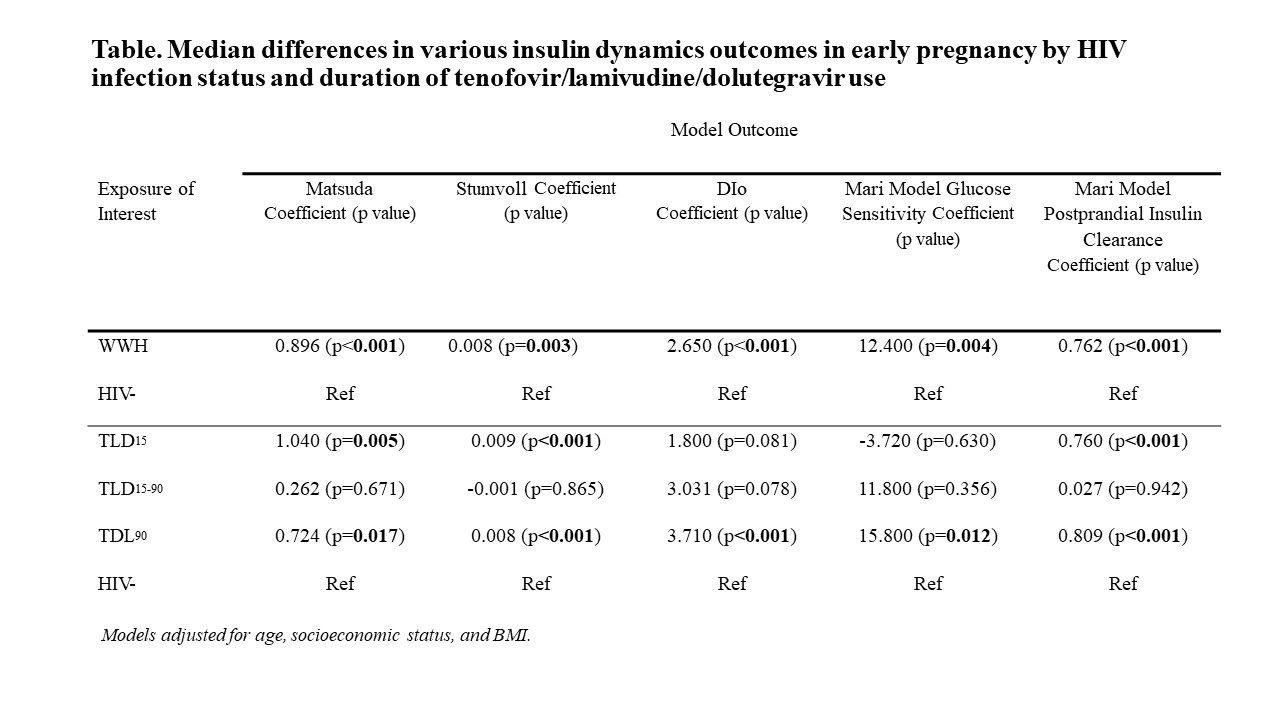
894 women were included (357 WWH, 537 HIV-); among WWH 109 were TLD<15, 34 TLD15-90, and 214 TLD>90. WWH were older than HIV- women (median 29 vs 26 years), but their median (interquartile range) BMI [29.8 (25.0-35.0 kg/m2)], GA [10 (9.0-12.7 weeks)] and rates of gestational diabetes or frank diabetes at OGTT did not differ. Among WWH, 7% had CD4 <200 cells/mm3 and 25% HIV RNA >50 copies/mL at enrollment. After adjusting for age, BMI and socioeconomic status, WWH had higher Matsuda, Stumvoll, DIo, and Mari-derived glucose sensitivity & postprandial insulin clearance than HIV- women (all p<0.004). (Table). Compared to HIV- women, TLD<15 and TLD>90 were associated with higher Matsuda, Stumvoll, and mean postprandial insulin clearance (all p<0.05), whereas only TLD>90 was associated with higher DIo and glucose sensitivity (p<0.001 for both).
Conclusions
WWH receiving TLD have higher insulin sensitivity and beta-cell function than HIV-women, with higher duration on TLD having a more favorable effect on beta-cell function in early pregnancy. Our findings suggest that pregnant WWH receiving TLD may be at reduced risk for diabetes in early pregnancy compared to HIV- women. Longitudinal studies in pregnant WWH will be useful to understand whether this favorable profile persists.
Table or Figure