Background
Various distance to care (DTC) measures exist. It is unclear which most accurately predicts injection visit adherence for persons with HIV receiving long acting injectable (LAI) cabotegravir/rilpivirine (CAB/RPV). Objectives were to: i) identify which DTC measures were associated with injection visit no-shows (IVNS) and ii) compare the strength of association of each DTC measure when evaluated as an independent predictor of IVNS among recipients of LAI CAB/RPV.
Methods
A retrospective cohort study was performed among recipients of LAI CAB/RPV between 05/2021 and 08/2023 at an urban HIV medicine clinic. Inclusion criteria were: i) age ≥18 years, ii) received CAB/RPV for ≥6 months, and iii) availability of address in electronic medical record. Individuals with a post office box as their address were excluded. Five measures were estimated to measure distance between home address and clinic address: i) door-to-door mileage, ii) driving time, iii) public transit time, iv) walking time and v) biking time. All analyses were restricted to those with a door-to-door mileage of <15 miles as the non-driving DTC measures would not be realistic without a motor vehicle. Classification and regression tree (CART) analyses were performed to identify breakpoints in each of these continuous DTC measures associated with no shows. Each of these DTC variables were entered into a Cox proportional hazards regression model to determine the strength of association after controlling for other potential predictor variables.
Results
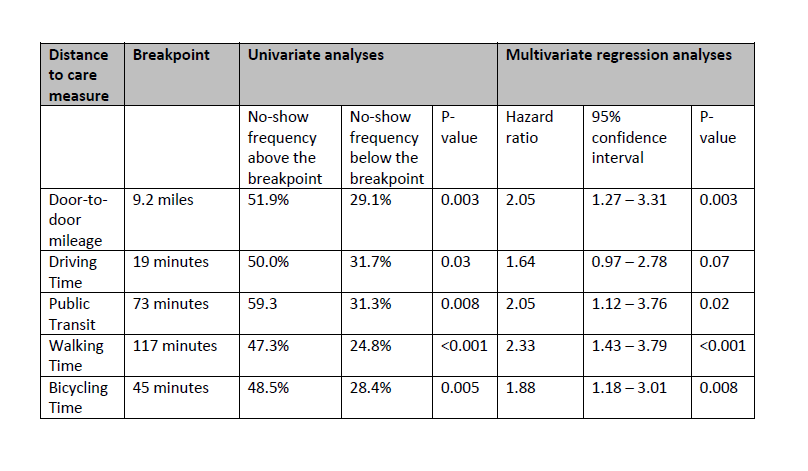
Among the 202 individuals evaluated, median age (interquartile range, IQR) was 43 (34 – 54) and median (IQR) time on CAB/RPV was 451 (356 – 552) days. Most (91%) were assigned male sex at birth. The Table displays the CART-derived breakpoints for each DTC variable. For each DTC measure, there was a significantly higher proportion of IVNS for persons above the breakpoint than below. In multivariate analyses (Table) adjusting for other potential predictor variables, each DTC measure was independently associated with IVNS with the exception of driving time ≥ 19 minutes. Walking time ≥ 117 minutes (Hazard ratio, HR: 2.33) had the strongest measure of association with IVNS.
Conclusions
Several DTC measures with CART-derived breakpoints were independently associated with IVNS among recipients of LAI CAB/RPV. Future studies should consider incorporating CART into the DTC measure used to predict injection visit adherence.
Table or Figure