Background
Dolutegravir (DTG) and Efavirenz (EFV) have been associated with neuropsychiatric symptoms, which may impact adherence to antiretroviral therapy (ART) in pregnant and postpartum people living with HIV. However, their impact on postpartum mental health remains insufficiently understood. We compared depression, sleep disturbances and anxiety between DTG and EFV treatment in pregnant and postpartum people living with HIV in nine countries.
Methods
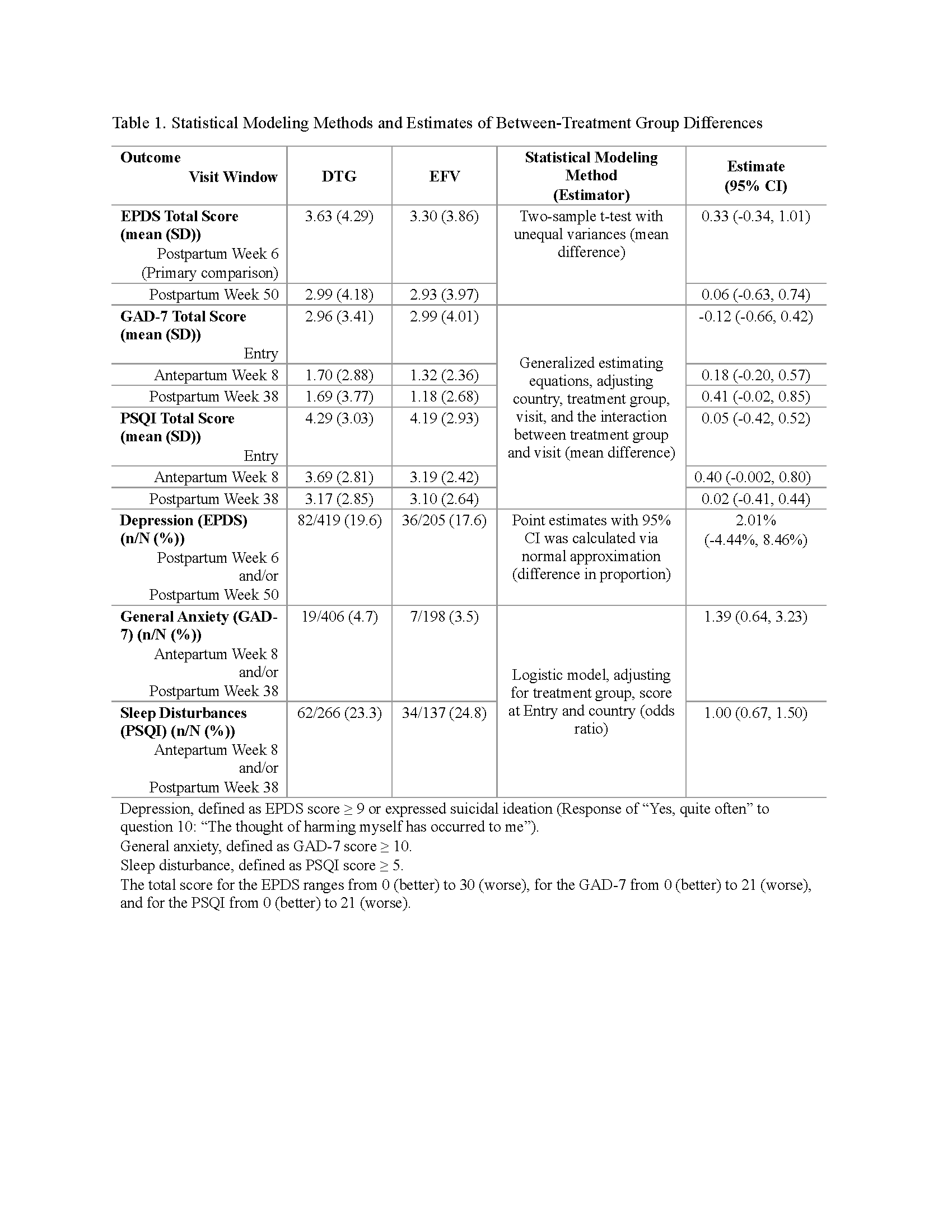
In IMPAACT 2010, pregnant people with HIV were randomized to DTG + emtricitabine (FTC)/tenofovir alafenamide (TAF), DTG+FTC/tenofovir disoproxil fumarate (TDF), or EFV/FTC/TDF arm at 14-28 weeks’ gestation and were followed through 50 weeks postpartum. Depression was assessed using the Edinburgh Postnatal Depression Scale (EPDS) at Postpartum (PP) Weeks 6 and 50. Sleep disturbances and anxiety were evaluated using the Pittsburgh Sleep Quality Index (PSQI) and Generalized Anxiety Disorder 7-item Scale (GAD-7) at Entry, Antepartum (AP) Week 8 and PP Week 38. Statistical modeling methods are detailed in Table 1.
Results
643 participants were randomized (432 to DTG and 211 to EFV), with a mean (standard deviation) age of 27.4 (6.0) years and 91.0% (585/643) as Black African. The depression proportion at PP Week 6 and/or 50 was 19.6% (82/419) in DTG and 17.6% (36/205) in EFV, with a difference (DTG – EFV) of 2.01% (95% confidence interval [CI]: -4.44%, 8.46%). The mean difference in EPDS scores was 0.33 (95% CI: -0.34, 1.01) at PP Week 6 (primary) and 0.06 (95% CI: -0.63, 0.74) at PP Week 50. The anxiety proportion at AP Week 8 and/or PP Week 38 was 4.7% (19/406) in DTG and 3.5% (7/198) in EFV among participants without anxiety at Entry. For GAD-7 scores, the mean difference was 0.18 (95% CI: -0.20, 0.57) at AP Week 8 and 0.41 (95% CI: -0.02, 0.85) at PP Week 38. The sleep disturbance proportion at AP Week 8 and/or PP Week 38 was 23.3% (62/266) in DTG and 24.8% (34/137) in EFV among participants without sleep disturbances at Entry. The mean difference in PSQI scores was 0.40 (95% CI: 0, 0.80) at AP Week 8 and 0.02 (95% CI: -0.41, 0.44) at PP Week 38.
Conclusions
This study showed a similar proportion of depression, anxiety, and sleep disturbances between DTG and EFV, with roughly one in five women experiencing postpartum depression across all ART regimens. These findings highlight the importance of screening for mental distress in pregnant people living with HIV and considering postpartum well-being.
Table or Figure