Background
To achieve hepatitis C elimination in the United States (US), understanding comorbidities among people living with chronic hepatitis C is crucial to inform prevention and treatment approaches. We aimed to quantify and characterize the prevalence of HIV, sexually transmitted infections (STIs), mental health disorders, substance use disorders, and drug overdose among Medicaid enrollees diagnosed with chronic hepatitis C in the US.
Methods
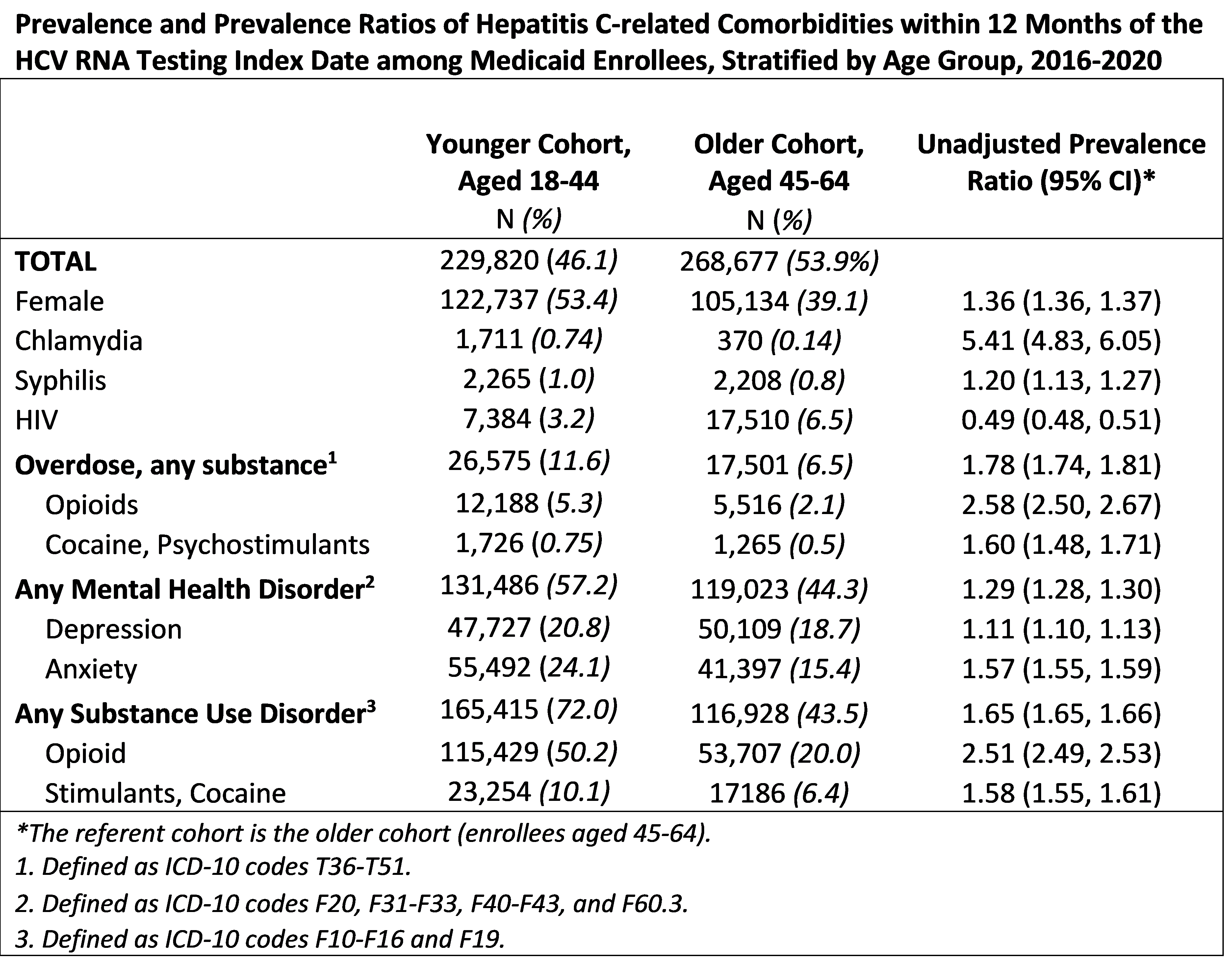
We used CMS Transformed Medicaid Statistical Information System (T-MSIS) data to identify a cohort of Medicaid enrollees with chronic hepatitis C. We defined enrollees with chronic hepatitis C as persons with an HCV RNA code (CPT 87520, 87521, or 87522) index date during 2016 to 2020, with an ICD-10 chronic hepatitis C code (B18.2) ≥1 day after the index date. Persons aged 18-64 years enrolled in Medicaid for at least 12 months after their index date and not dually enrolled in Medicare were included. We estimated the prevalence of comorbidities documented within 12 months of the index date: HIV, chlamydia, syphilis, mental health disorders, substance use disorders, and drug overdose. Due to two distinct age-based chronic hepatitis C distributions, we stratified results by age group (18-44 and 45-64) using bivariate log-binomial regression to generate prevalence ratios (PR).
Results
Among Medicaid enrollees from 2016 to 2020, 498,497 persons met the inclusion criteria for chronic hepatitis C. A higher percentage (53%) of those aged 18-44 (n=229,820) were female compared to (39%) of those aged 45-64 (n=268, 677). In unadjusted models, enrollees aged 18-44 were less likely to have an HIV diagnosis (PR=0.49, 95% CI: 0.48, 0.51) compared to older enrollees. In contrast, younger enrollees were more likely to be diagnosed with a comorbidity than those aged 45-64, including chlamydia (PR=5.41, 95% CI: 4.83, 6.05), drug overdose (PR=1.78, 95% CI: 1.74, 1.81), and mental health disorder (PR=1.65, 95% CI: 1.65, 1.66).
Conclusions
We found that STIs, drug overdose, and mental health disorders are common among persons with chronic hepatitis C enrolled in Medicaid and observed distinct patterns by age group. The higher prevalence of comorbidities, excluding HIV, among the younger cohort may indicate a need for targeted services to support hepatitis C treatment and care, as well as linkage for mental health disorder treatment, substance use treatment, and other infectious disease prevention services.
Table or Figure