Background
Clinic transfers in African countries with high HIV burdens are common, but nationally representative data on clinic switching are scarce, and the relationship between facility switching and HIV care engagement is poorly understood, especially at the population level.
Methods
We pooled data from six Population-based HIV Impact Assessment (PHIA) surveys (2020-21) in Eswatini, Lesotho, Malawi, Mozambique, Uganda, and Zimbabwe to estimate the prevalence and characteristics of past-year HIV clinic switching, as well as its association with HIV viral load (VL), in log10 RNA copies/mL, and past-month antiretroviral therapy (ART) non-adherence (missing 2+ doses). Using multistage cluster sampling, PHIA recruited nationally representative samples of persons completing structured bio-behavioral surveys, including serologic HIV status confirmation and plasma VL quantification. Multivariable weighted logistic regression with jackknife variance estimation, reported as adjusted odds ratios (aOR) with 95% confidence intervals (CI), quantified correlates and HIV care outcomes of clinic switchers relative to non-switchers—overall and stratified by sex and past-year mobility (spending 30+ days away from home), respectively.
Results
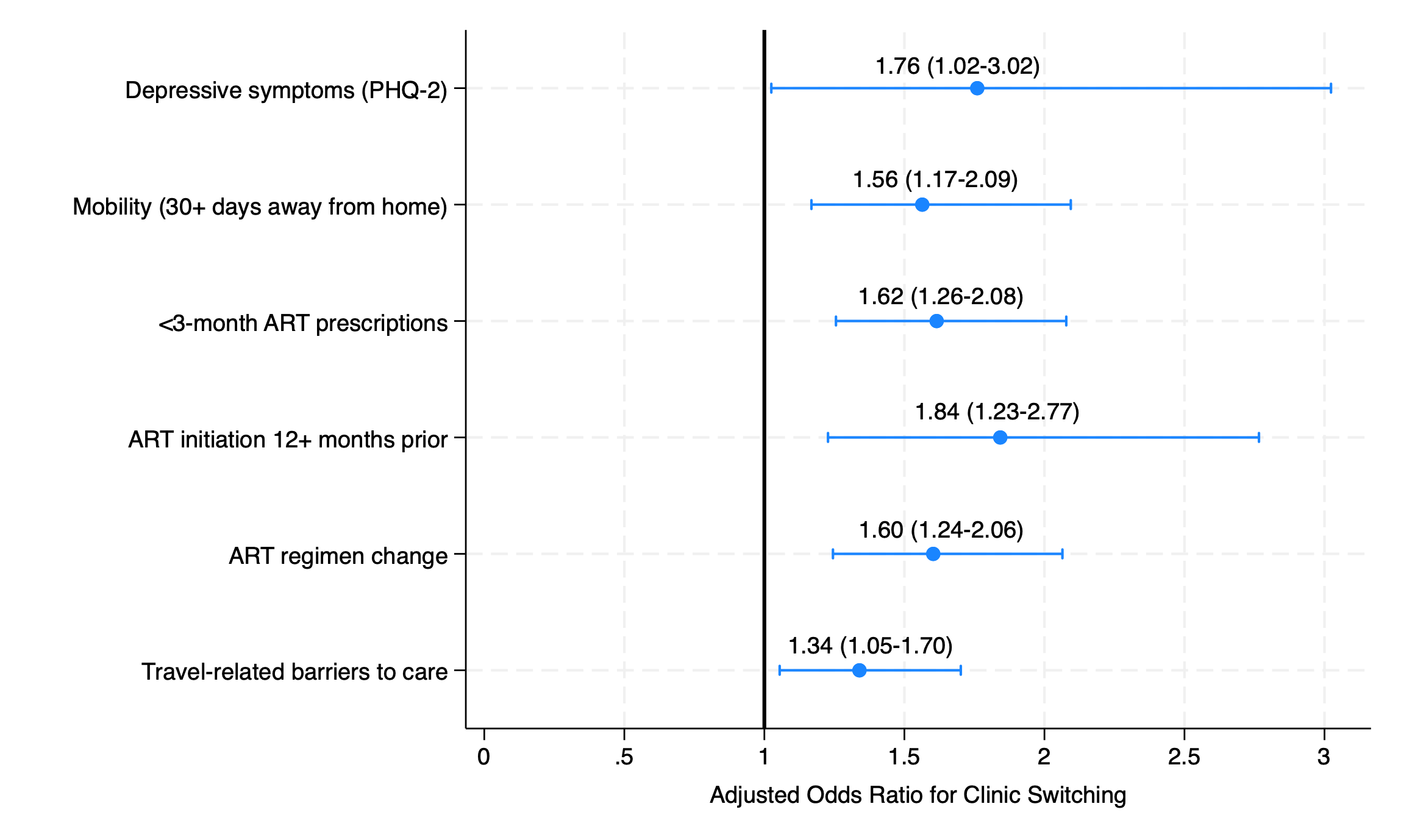
Of the 118999 participants across 56759 households, 12551 (10.5%) were living with HIV and reported current ART use (mean age: 41.0 years, 65.9% female, 12.7% mobile, 92.4% VL <1000 copies/mL). The prevalence of HIV clinic switching was 14.5%, ranging from 9.8% in Mozambique to 21.4% in Uganda. Clinic switching was more common in persons with depressive symptoms, past-year ART regimen changes, longer-term (12+ months) ART use, ART prescription duration <3 months, travel-related barriers to clinic visits, and past-year mobility (Figure). While observed multivariable correlations between clinic switching and HIV clinical outcomes were null overall ([elevated VL, per log10 unit-increase] aOR=1.02, CI: 0.97-1.08; [ART non-adherence] aOR=1.18, CI: 0.86-1.61), clinic switching was significantly associated with elevated VL in mobile persons (aOR=1.07, CI: 1.02-1.13) and females (aOR=1.06, CI: 1.01-1.11), as well as ART non-adherence in mobile persons (aOR=1.90, CI: 1.01-3.55).
Conclusions
We observed high frequencies of facility switching at population level and elevated odds of viremia in mobile persons and females with clinic transfer histories. Optimizing efficiency and ease of clinic transfers to prevent care disruptions is imperative for HIV epidemic control efforts in Africa.
Table or Figure