Background
People living with HIV (PLHIV) using antiretroviral therapy (ART) are exposed to persistent low grade of inflammation, which may accelerate aging. However, the impact of various ART regimens on residual inflammation and accelerated aging remains largely unclear. This study investigates the relationship between cumulative ART exposure and age acceleration in virally suppressed PLHIV on ART.
Methods
Data from 1,875 PLHIV in the 2000HIV cohort (NCT03994835) were used to analyze cumulative ART exposure (in years), categorized by regimen and drug class, with detailed treatment data available for each participant. Age acceleration was assessed using biological clocks based on targeted proteomics (proteomic clock) and genome-wide methylation data (epigenetic clocks: Horvath, Hannum, PhenoAge, and GrimAge). Plasma protein levels (n=3072) were measured via proximity extension assay, and genome-wide DNA methylation was profiled using the Illumina MethylationEPIC array. We first examined the relationship between cumulative ART exposure and age advancement score using five biological clocks. We then performed differential expression analyses (DEA) and pathway enrichment analyses of proteomic data to elucidate underlying mechanisms.
Results
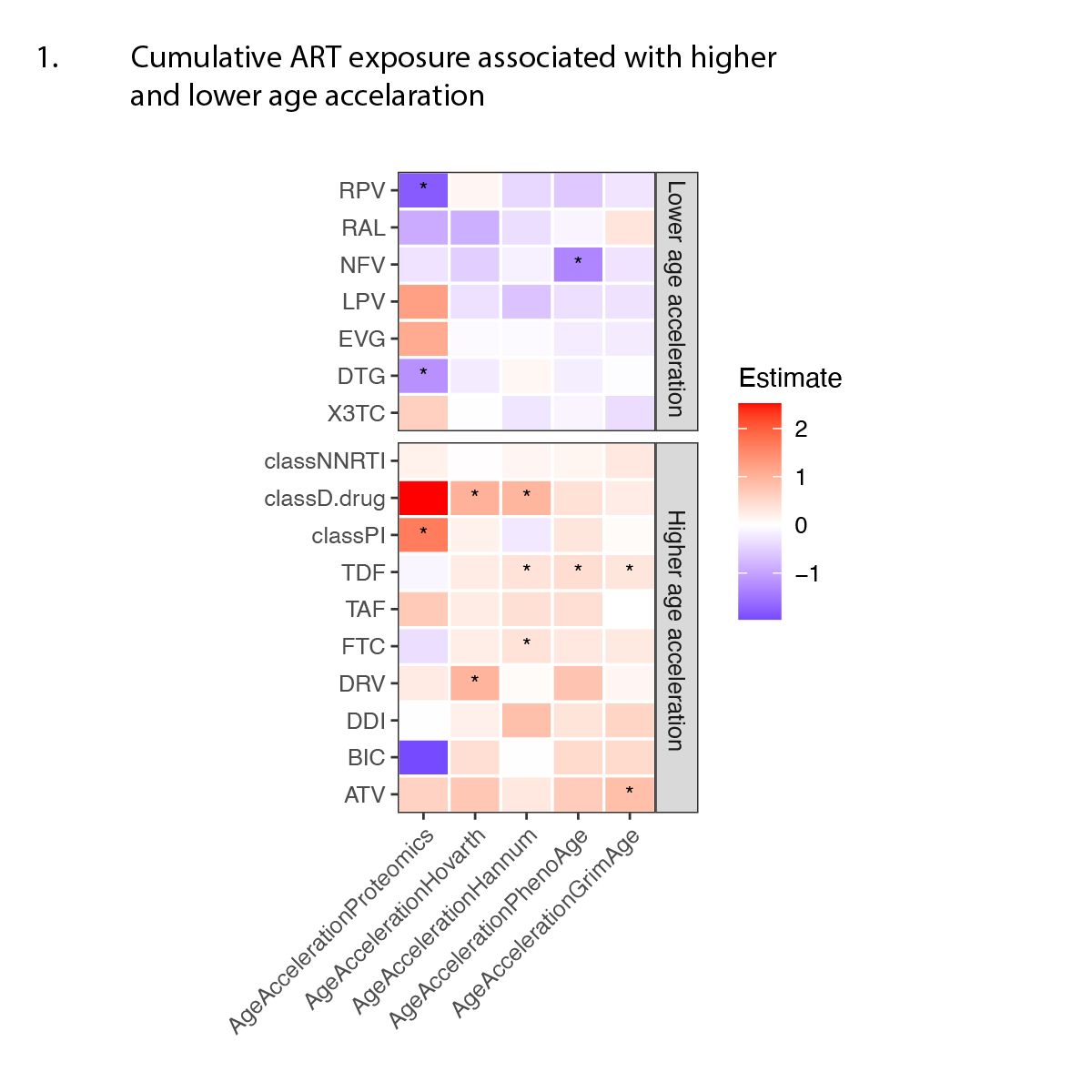
Proteomic and methylation clocks were strongly correlated. Participants aged 36–60 showed faster epigenetics age acceleration compared to both younger (18–35) and older (60+) participants (P<0.05). Longer cumulative exposure to dolutegravir (DTG), rilpivirine (RPV) and nelfinavir (NFV) was associated with lower age advancement scores on at least a biological clock. In contrast, longer exposure to tenofovir disoproxil fumarate (TDF), emtricitabine (FTC), darunavir (DRV), atazanavir (ATV), and dideoxynucleoside analogues (d-drugs) was related to higher age advancement scores (Figure 1; P<0.05, adjusted for chronological age). The effect of cumulative drug exposure on proteomic and methylation clocks was largely consistent. In participants exposed to DTG and RPV, DEA revealed significant downregulation of innate immune pathways, including cytokine and chemokine response, apoptotic process, and neutrophil chemotaxis, while exposure to DRV, ATV was associated with upregulation of these pathways.
Conclusions
Cumulative ART exposure influences age acceleration in PLHIV, with distinct effects across regimens and drug classes. Innate immune pathways appear to be key drivers of these effects and are promising therapeutic targets to mitigate accelerated aging.
Table or Figure