Background:
The median age of people with HIV (PWH) in USA is now over 50. This aging HIV+ population is facing increasingly significant risk of other neurodegenerative diseases-in addition to HIV brain disease-especially Alzheimer’s disease. We investigated the potential impact of HIV-disease, APOE4 (E4), and their interactions on white matter (WM) microstructure in a cohort of middle-aged to older PWH.
Methods:
Seventy-six adults (44-69 y.o. (56.4±6.3), 24 female, 58 PWH) participated in this study. All diffusion weighted images were preprocessed in FSL then analyzed using the automated fiber quantification (AFQ) software in Python. AFQ produced fractional anisotropy (FA) and mean diffusivity (MD) values at each of 100 equidistant nodes along each of 22 major WM bundles. We analyzed group differences along each tract for both FA and MD using pointwise t-tests with FDR correction to investigate the impact of HIV and E4 status on FA and MD values. Significant regions of group differences were defined by pFDR<0.05 with at least two adjacent nodes. Region-of-interest (ROI) based analyses were conducted on these significant regions to investigate the interactions between age, E4, and HIV-disease.
Results:
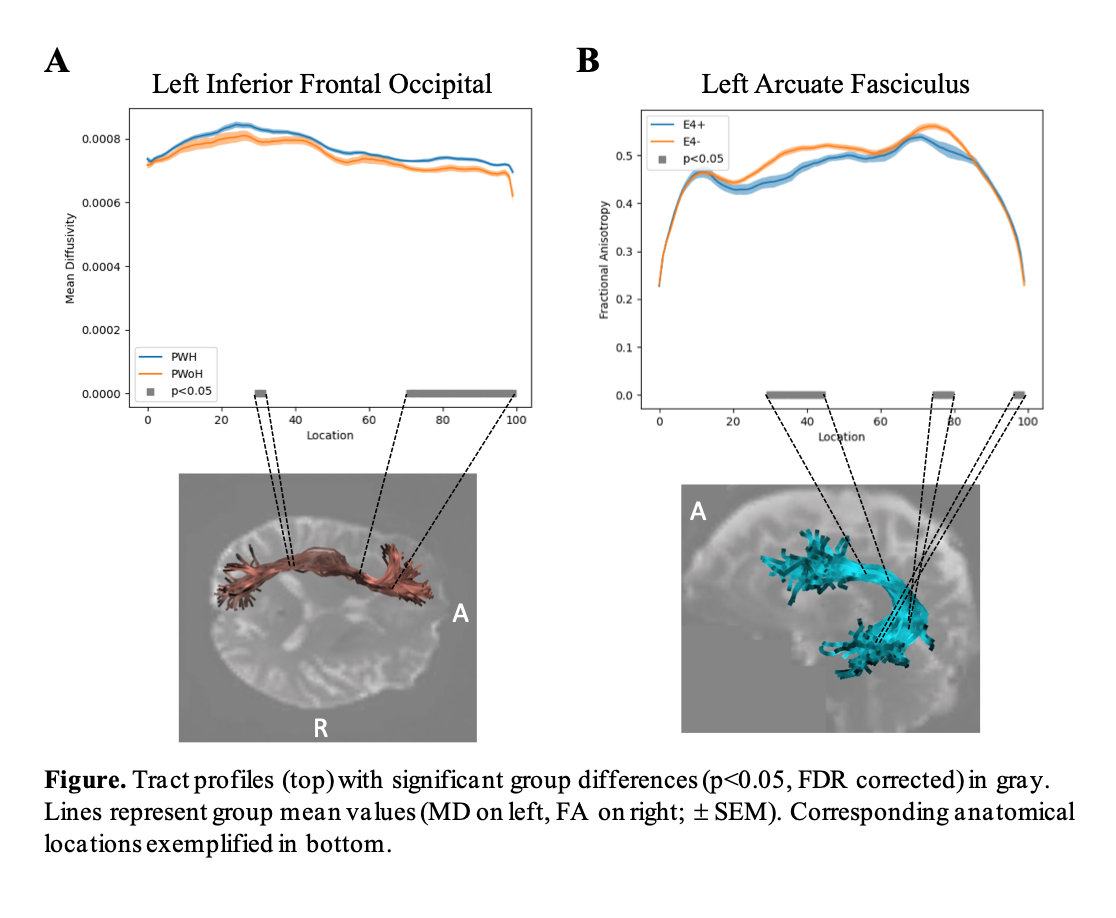
Compared to controls, PWH showed trends of increased MD along all 22 bundles, with significant regions of group differences along the left inferior frontal occipital (Fig. A) and left uncinate tracts. ROI-based analyses revealed significant interactions between HIV-status and age in all these regions (at least p<.004), with a steeper age-related increase in MD in PWH. Across PWH and controls, E4 carriers had significantly reduced FA in multiple regions of the left arcuate fasciculus versus non-carriers (Fig. B). In PWH, the E4 effect remained significant (p<.001), and importantly, ROI-based analyses revealed significant interactions between E4 status and HIV disease duration in most of these regions, with a steeper disease duration-related decline in FA in PWH E4 carriers (after controlling for age, ps<.045).
Conclusions:
HIV and APOE4 differentially impact white matter microstructure in middle-aged to older adults with HIV. Specifically, HIV-disease is associated with wide-spread increases in MD, and older PWH are disproportionally affected. By contrast, E4-associated FA reduction is more localized, and PWH E4 carriers with long disease duration are at a greater risk. These findings warrant further examination of more localized WM changes along individual tracts in the rapidly aging HIV+ population.