Background:
Results from some trials of HIV treatment suggest an excess risk of hypertension (HTN) associated with integrase strand transfer inhibitors (INSTIs), independent of changes in weight or BMI. HPTN 083, in HIV-negative MSM and transgender women, compared injectable cabotegravir (CAB) to daily oral tenofovir disoproxil fumarate-emtricitabine (TDF-FTC) for HIV PrEP. We performed a post-hoc analysis of HPTN 083 to compare incidence rates for HTN in the absence of HIV infection.
Methods:
Of 4566 participants (ppts) enrolled, the analysis population included 3971 (1993 CAB/1978 TDF-FTC) exposed to study drug and without pre-existing HTN. Incident hypertension was defined as a new diagnosis of HTN, 2 sequential measures of SBP ≥ 140 mm Hg, DBP ≥ 90 mm Hg, or initiation of anti-HTN treatment, through 161 weeks of follow-up. Changes in blood pressure over time by study arm were estimated with mixed effect models. Cox regression models were used to estimate the hazard ratio (HR) for incident HTN between study arms, unadjusted and adjusted for race, age, baseline (BL) BMI, anti-HTN treatment, and time-updated weight change from BL (TUWC).
Results:
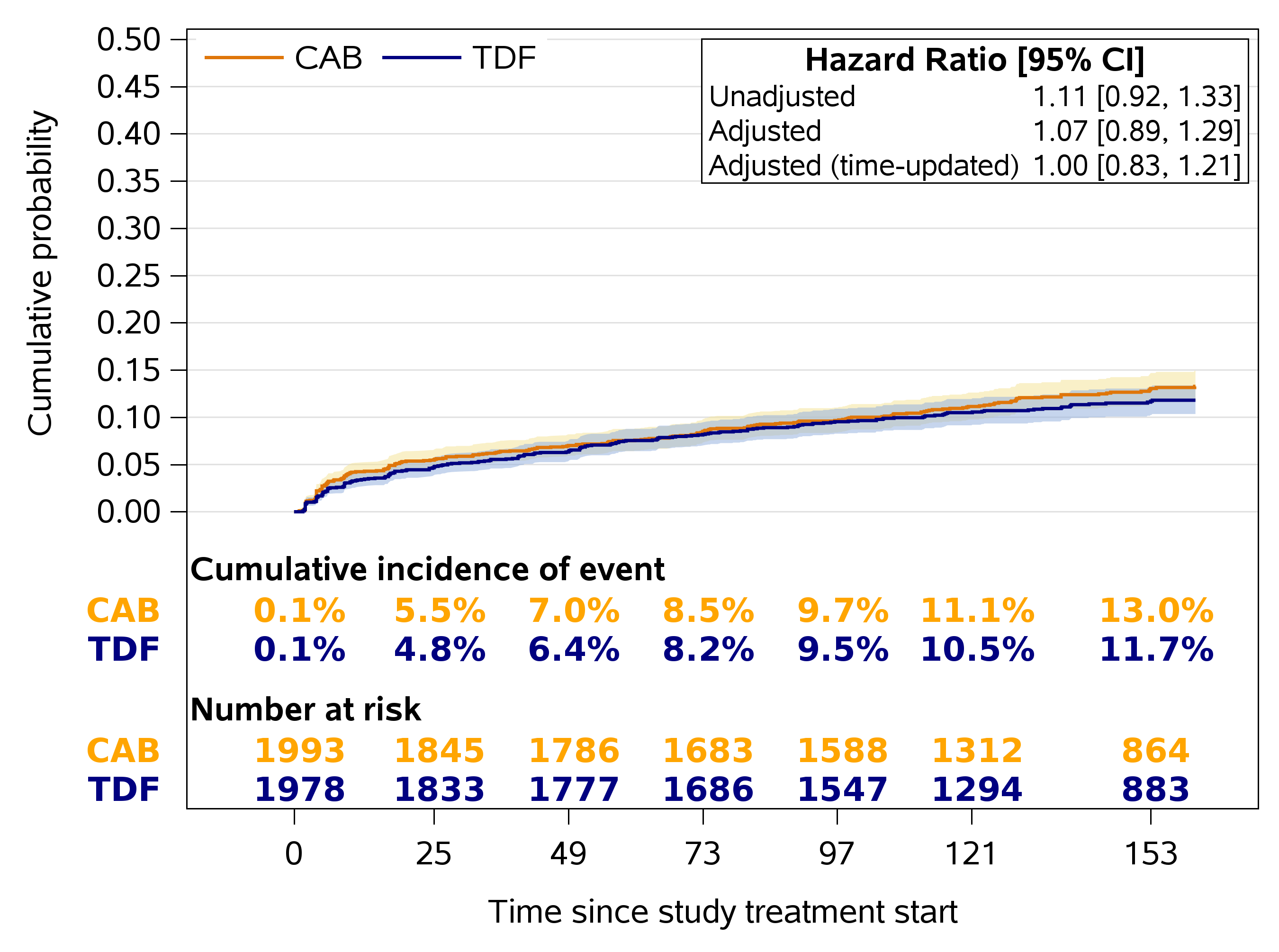
Ppts were well matched between groups; 75% were under age 30; 4% were over age 45. 58% were normal or underweight at baseline. Over 10293 person-years of follow-up, median BMI increased +1.2 (IQR 0.1-2.3) kg/m2 for CAB and 0.8 (IQR -0.2-2.1) for TDF-FTC. BMI and SBP were weakly correlated. 461 (12%) ppts had incident HTN (246 CAB, 215 TDF-FTC). Mean change per year in SBP was 0.56 mm Hg (95% CI 0.41, 0.71) and DBP was 0.73 (0.62, 0.85) in CAB and 0.30 (0.15, 0.45) and 0.66 (0.55, 0.78) in TDF-FTC. Cumulative incidence of HTN over 3 years was 13.4% for CAB and 11.8% for TDF-FTC (Figure). HTN was more common in US and African ppts and those with higher BMI, older age, and taking anti-HTN meds for non-HTN indications (MFnH). Between-arm differences were numerically largest for US ppts, older ppts, and ppts taking MFnH. HR for incident HTN was 1.11 (95% CI 0.92, 1.33, p=0.28) for CAB vs. TDF-FTC in the unadjusted analysis, and 1.00 (95% CI 0.83, 1.21) after adjustment for race, BL age, BL BMI, anti-HTN BL meds, and TUWC.
Conclusions:
HTN incidence in HPTN 083 was low. Observed HTN incidence was higher in CAB vs. TDF-FTC, but was not statistically significant. Risk factors for HTN included age, BL obesity, and weight gain over time. Over 3 years there was no increase in the hazard of incident HTN in CAB vs. TDF-FTC after adjusting for relevant covariates.