Background:
The COVID pandemic highlighted the need to develop vaccine alternatives to prevent the spread of SARS-CoV-2, especially in immunosuppressed people. Q-GRFT, a broad-spectrum viral entry inhibitor, functions by binding oligomannose glycans on viral envelopes and is highly potent, with an IC90 of 645 ng/mL against the SARS-CoV-2 BA.5 variant. A nasal spray formulation was designed to deliver Q-GRFT to the upper respiratory mucosa for topical prophylaxis.
Methods:
PREVENT (NCT05180500) was a phase I randomized, double-blind, placebo-controlled study to determine the safety and drug persistence of 14 doses of Q-GRFT intranasal spray (two 100 μL bursts of 7.5 mg/mL Q-GRFT per nostril, 400 μL total). Healthy, SARS-CoV-2 -vaccinated participants aged 18-55 with normal nasal and pharyngeal exams were randomized 2:1 to either Q-GRFT (n=33) or placebo (n=17). Participants initially received one metered dose of the study drug; after establishing initial tolerance at 24 hours, participants self-administered the spray for 13 consecutive days. Grade 2 or higher adverse events (AEs) related to study product were compared between groups using Fisher’s exact test. Drug persistence was assessed by measuring Q-GRFT concentrations in nasopharyngeal (NP) and nares swabs. Systemic exposure and immune response were measured by Q-GRFT and antidrug antibody (ADA) concentrations in plasma. Acceptability was assessed by questionnaire.
Results:
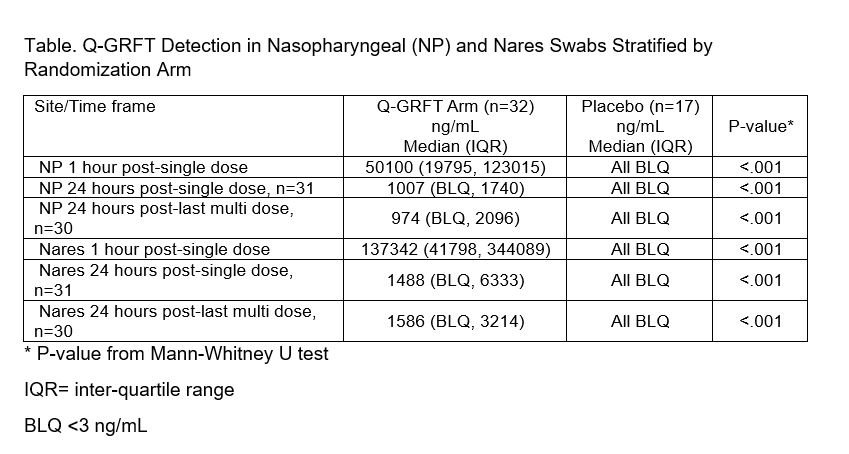
There was no difference in the proportion of participants with related Grade 2 or higher AEs between groups. The most frequent AEs were mild nasal irritation and congestion; two participants in the Q-GRFT arm withdrew due to nasal congestion. After adjusting for the dilution factor, Q-GRFT was detected at 50-200X the IC90 in NP and nares swabs at 1 hour and at 1-2X the IC90 at 24 hours after use (Table); results did not differ by sex. ADA was detectable in low levels in plasma in 46% of participants; ADA’s impact on antiviral activity is being assessed. No Q-GRFT was detected in plasma samples (lower limit of quantitation: 3 ng/mL). Acceptability of the nasal spray (somewhat or highly acceptable) was similar between the two groups (87% Q-GRFT vs. 100% placebo, P= 0.28).
Conclusions:
The Q-GRFT nasal spray administered for a total of 14 doses was well tolerated and demonstrated persistence up to 24 hours in clinically important anatomic sites without systemic absorption. This nasal spray could address the need for an on-demand product for prevention of SARS-CoV-2.