Background:
Little is known about the capacity of HIV therapeutic vaccines to overcome pre-existing immunodominance hierarchies and elicit functional, long-lived new or boosted HIV-specific CD8+ T cell responses. We previously reported therapeutic vaccine-induced new and boosted HIV-specific T cell responses in people with HIV on ART in the PENNVAX trial. We now characterize the magnitude, proliferative capacity, and durability of these responses.
Methods:
Participants received gag+pol+IL-12 DNA (GP, n=11), gag+pol+env+IL-12 DNA (GPE, n=15), or placebo (n=13) vaccination via intramuscular electroporation. Individual Gag peptide-specific T cell responses (vaccine-matched 15-mer peptides) were measured via IFNγ ELISpot at baseline (BL), 2 weeks after the last vaccine (Week [Wk] 14), and at Wk48. Responses were defined as ‘new’ at Wk14 if they were absent at BL with a fold change (FC)≥2, and ‘boosted’ if present at BL and Wk14 with FC≥2. We then performed a 6-day in vitro peptide stimulation assay with Cell Trace Violet (CTV) to discern CD4+/CD8+ identity and quantify the proliferative capacity of the responses (%CTVlo of total CD4+ or CD8+ T cells).
Results:
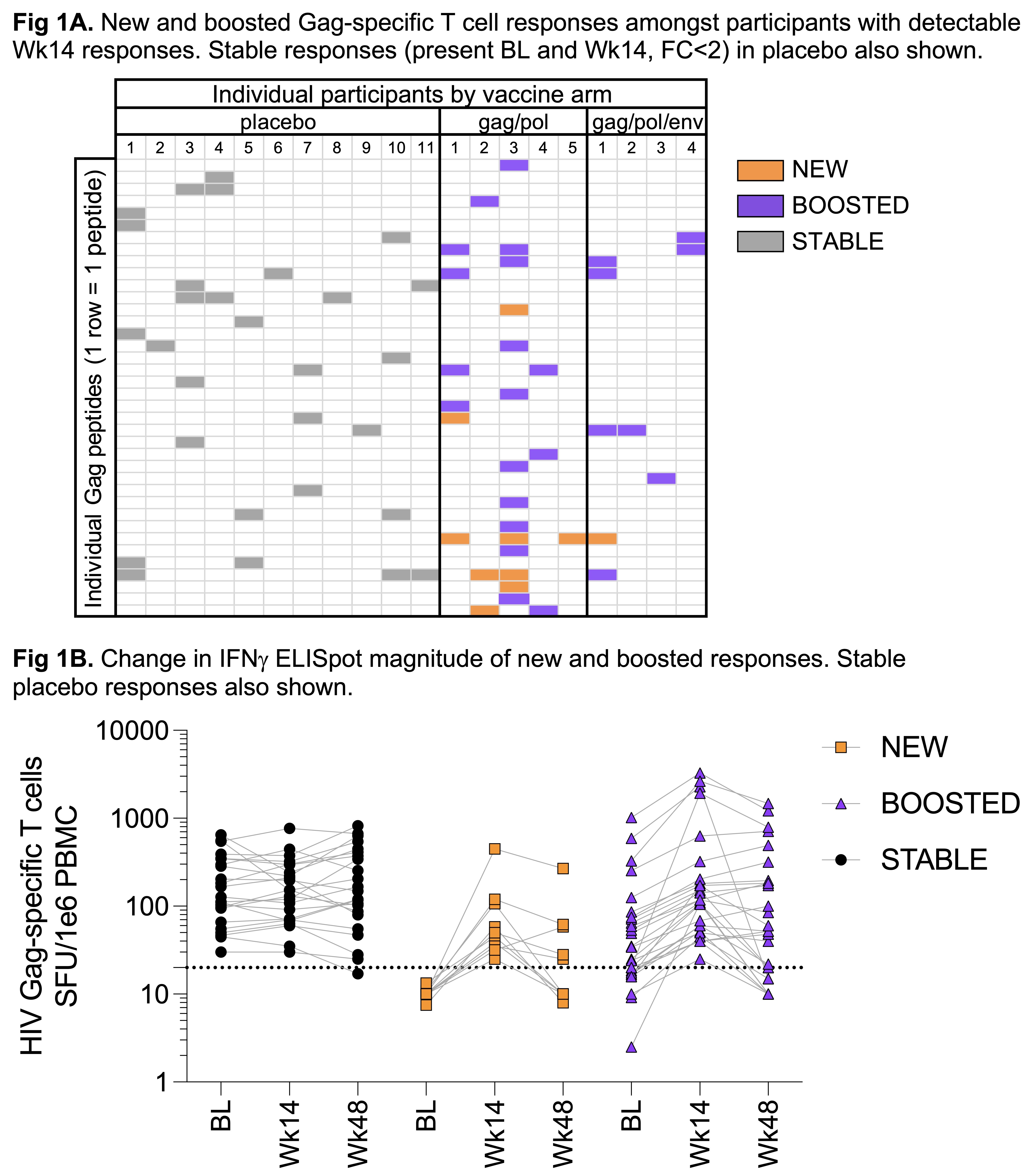
At Wk14 versus BL, 10 new Gag-specific T cell responses formed in 5 vaccinated participants (4 in GP arm, 1 in GPE) and 26 Gag-specific T cell responses were boosted in 8 vaccinated participants (4 in GP, 4 in GPE; Fig 1A); there were no new or boosted responses in the placebo group. CD8+ T cells responded to 4 of the new and 20 of the boosted peptides. New responses had a median [IQR] magnitude of 48 [36-95] SFU/1e6 PBMC and proliferation of 1.89% [1.13-4.43%]. Between BL and Wk14, boosted response magnitude increased from 23 [17-70] to 114 [60-179] SFU/1e6 PBMC (p=0.02 boosted vs new at Wk14). Proliferation of boosted responses was unchanged (0.70% [0.41-1.00%] at BL, 0.91% [0.39-2.27%] at Wk14). At Wk48, 5 of the new responses remained detectable, and 11 of the boosted responses remained ≥2 fold above BL magnitude (Fig. 1B).
Conclusions:
HIV DNA therapeutic vaccination both boosted pre-existing T cell responses and also elicited responses against new epitopes. The higher magnitude of boosted responses by IFNγ ELISpot post-vaccination yet similar proliferative responses suggest their per-cell proliferative capacity is lower than that of new responses. Eliciting new T cell responses may be required in order for HIV therapeutic vaccines to enhance T cell function.