Background:
Bictegravir (BIC), co-formulated in a tablet with tenofovir alafenamide and emtricitabine, is being increasingly prescribed to pregnant persons with HIV (PWH), yet limited birth outcome data have been reported.
Methods:
We conducted a descriptive analysis of PWH 18-45 years of age enrolled in at least one Pediatric HIV/AIDS Cohort Study (PHACS)-affiliated protocol who received BIC for at least 7 days during pregnancy and completed follow-up through delivery. The outcomes of interest were gestational age at birth, preterm birth (<37 weeks' gestation), gestational-age adjusted birth weight (BWZ) and length (BLZ) z-scores (CDC 2000 growth standards), small for gestational age (SGA, birthweight <10th percentile), congenital anomalies, neonatal deaths in the first 28 days of life, and infant HIV status. The prevalence [with Clopper-Pearson 95% Confidence Intervals (CIs)] of each outcome was calculated among infants exposed to BIC during gestation and, for the outcome of anomalies, in infants exposed during the first trimester. Maternal CD4 count and HIV viral load (VL) nearest and prior to delivery were reported if available.
Results:
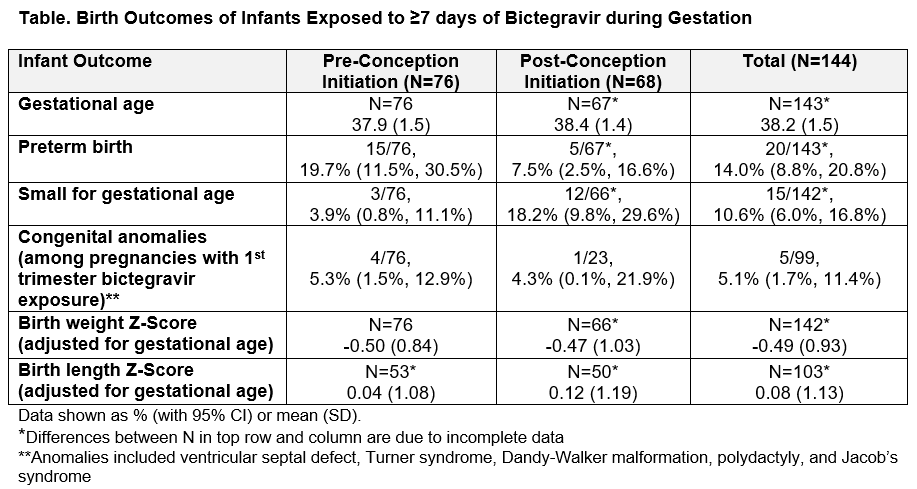
A total of 144 infants were born to 134 unique PWH (including 2 twin sets) who received BIC for at least 7 days during pregnancy. Infants were born between September 2018 and October 2023. Median maternal age at delivery was 29.7 years (interquartile range (IQR): 26.1, 33.9), 71% reported their race/ethnicity as Black or African American, and 52% had an annual household income ≤$20,000; all US census regions were represented. Fifty-three percent initiated BIC prior to conception. The mean gestational age was 38.2 weeks [standard deviation (SD)=1.5], the prevalence of preterm birth was 14.0% (95% CI: 8.8%, 20.8%) and SGA was 10.6% (95% CI 6.0%, 16.8%). Mean BWZ and BLZ were -0.49 (SD 0.93) and 0.08 (SD 1.13), respectively (Table). No neonatal deaths or perinatal HIV transmissions were reported. Among 99 infants exposed to BIC in the first trimester, 5 (5.1%, 95% CI 1.7%, 11.4%) had at least one congenital anomaly reported (Table). Maternal VL was <50 copies/mL in 82.0% and median CD4 count was 466.5 (IQR: 309.0, 744.0) cells/mm3 nearest to delivery of exposed infants.
Conclusions:
In this US cohort, BIC use during pregnancy was frequent. These findings provide initial reassuring observations about the potential safety of BIC use during pregnancy, although comparative data and continued surveillance of outcomes of antiretroviral therapy among PWH is warranted.