Background:
Current recommendations for post-exposure prophylaxis (PEP) for non-occupational HIV exposures include 28 days of daily oral antiretroviral drugs. However, low adherence, and inadequate regimen completion represents an important challenge. We examined whether a single injection of the combination of long-acting cabotegravir and rilpivirine (CAB LA and RPV LA) could be an effective PEP regimen in macaques.
Methods:
Human equivalent doses of CAB LA (50 mg/Kg) and RPV-LA (100 mg/Kg) were administered intramuscularly to 6 rhesus macaques 24 hours post rectal exposure to a single high dose of RT SHIV (10^3.3 TCID50). Infection outcome was compared to 7 untreated controls (3 real-time, 4 historical). Blood was collected through 43 weeks post challenge to monitor for plasma CAB and RPV levels and SHIV infection. Plasma CAB and RPV levels were monitored by LC-MS/MS. Poisson regression with robust error variance was applied to estimate PEP efficacy and confidence intervals.
Results:
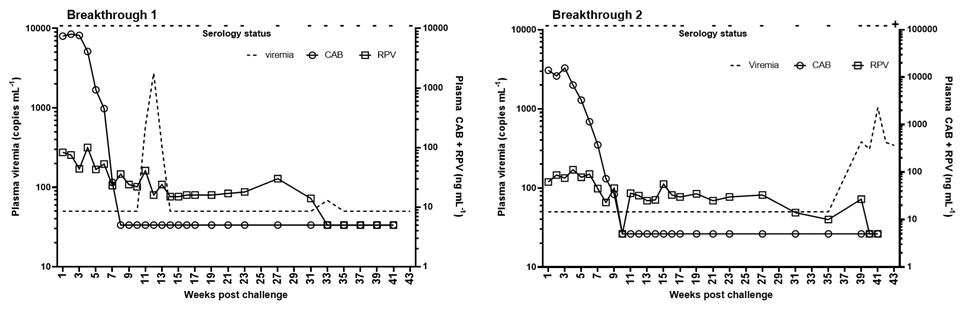
Median concentrations of CAB and RPV in plasma during the first 28 days after injection were within clinically relevant levels (5,860, range= 2,130-15,650 and 64.5, range= 20-127 ng/mL), respectively. All controls became viremic 7 days post challenge with a median plasma viral peak of 5.13 x 10^6 copies/mL. Four of the six treated macaques remained aviremic and seronegative through week 43 post challenge. The remaining 2 animals had detectable SHIV RNA at week 11 (breakthrough 1) and 39 (breakthrough 2) post-exposure. The calculated efficacy of CAB LA/RPV LA was 0.667 (95% CI= -0.0335, 0.893) (p=0.0571). Breakthrough 1 was characterized by transient low-level viremia between weeks 11 to 13 (range 327-2736 SHIV RNA copies/mL), a virus blip at week 33 (68 copies/mL), and absence of seroconversion. Breakthrough 2 had detectable viremia between weeks 39 and 43 (range 309-1033 SHIV RNA copies/mL) when CAB and RPV were low or undetectable in plasma and seroconverted at week 43 (Figure 1).
Conclusions:
We observed in our high dose rectal SHIV challenge model that a single dose of CAB LA and RPV LA given 24 hours after virus exposure provided clinical drug exposures for 4 weeks but was partially effective. Late and transient detection of SHIV RNA in breakthrough infections with or without seroconversion is similar to findings in persons failing prophylaxis with CAB LA and highlights diagnostic challenges of this PEP modality. Our results underscore the limitations of single-dose CAB LA and RPV LA use for PEP in humans.