Background:
Nonprofessional Post-Exposure Prophylaxis (nPEP) protects against HIV infection after risk exposure, but a prompt start is essential. According to the Italian guidelines, nPEP should be started within 24 hours after the exposure (preferably in the first 4 hours), but can be prescribed up to 72 hours. Aim of this study is to describe factors associated to users’ presentation time to our Emergency Department (ED) asking for nPEP.
Methods:
Retrospective Monocentric Observational study including all individuals who consecutively accessed our ED asking for nPEP between January 2011 and July 2023. We collected demographic data, information about type of exposure, sexual orientation and additional risky behaviours, eventual previous nPEP courses or HIV testing, and presentation time to ED. Descriptive statistics and nonparametric tests were used to describe study population. Unadjusted and adjusted binary regression analyses were performed to test factors associated to an early (within 24 hours) presentation.
Results:
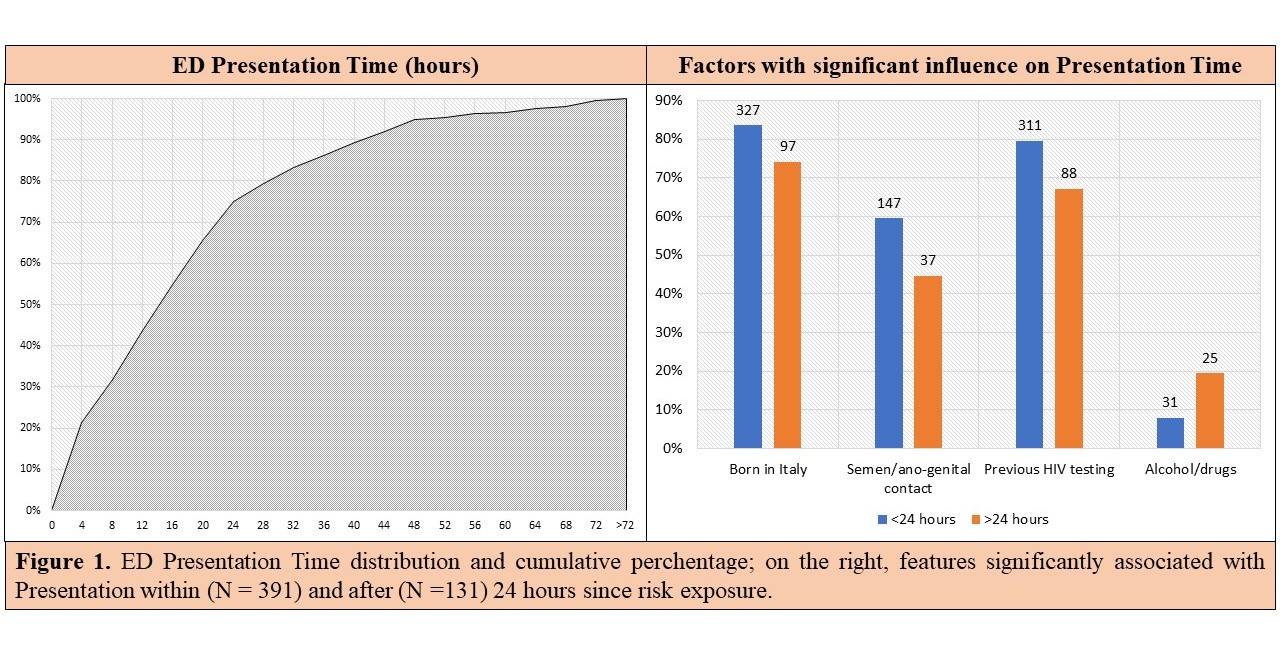
The analysis included 522 persons who accessed ED asking for nPEP: 486 (93.1%) were males, 354 (67.8%) MSM, 97.2% of them declared sexual intercourse as risk exposure. Median presentation time overall between biological exposure and ED presentation was 14.7 hours: 519 (99.4%) individuals accessed to our ED within 72 hours, 391 (74.9%) in the first 24 hours but only 111 (21.3%) within 4 hours (Figure 1). Median waiting time in ED before nPEP start was 1.4 hours. Multivariate binary regression analysis found that Italian nationality (OR 2.04, 95% CI 1.06-3.91, p=0.032), semen/ano-genital direct contact (OR 2.09, 95% CI 1.21-3.59, p=0.008) and previous HIV testing (OR 3.00, 95% CI 1.48-6.07, p=0.002) were significantly associated with presentation within 24 hours after exposure, while sexual intercourse under the effect of alcohol or recreational drugs was associated with late presentation after 24 hours (OR 0.33, 95% CI 0.15-0.73, p=0.006). No significant effect was detected for type of sexual intercourse, sexual orientation, HIV status of source individual, and previous nPEP courses.
Conclusions:
The majority of nPEP users accessed the ED within 24 hours after at risk contact, even if they had to wait often more than 1 hour for nPEP prescription. Use of alcohol and recreational drugs (including Chemsex practices) during sexual intercourses represents an important risk factor for HIV acquistion not only in terms of dangerous exposure, but also for delayed nPEP start.