Background:
Obstructive lung disease (OLD) is increasingly common among persons with HIV (PWH). The role of proteases in HIV associated OLD is unknown.
Methods:
We performed mass spectrometry (MS) analysis on endogenous peptides and tandem mass tagging for protein analysis on bronchoalveolar lavage fluid (BALF) samples from PWH with OLD (n=25) and without OLD (n=26) matched on smoking status and ART. We combined untargeted MS and targeted Somascan aptamer-based proteomic approaches to quantify individual proteases and their correlation with lung function. We mapped endogenous peptides to their native proteins that were subjected to protease activity and the accompanying proteases responsible for the peptide cleavages. We used t-tests to compare average FEV1pp between samples in which each cleaved protein was detected versus absent. We accounted for multiple comparisons using a false discovery rate (FDR) adjustment. Using the MEROPS database, we identified candidate proteases for peptide generation by quantifying their affinity to binding sites via z-scores. We assigned proteases as likely responsible for cleavage by the z-scores for each peptide.
Results:
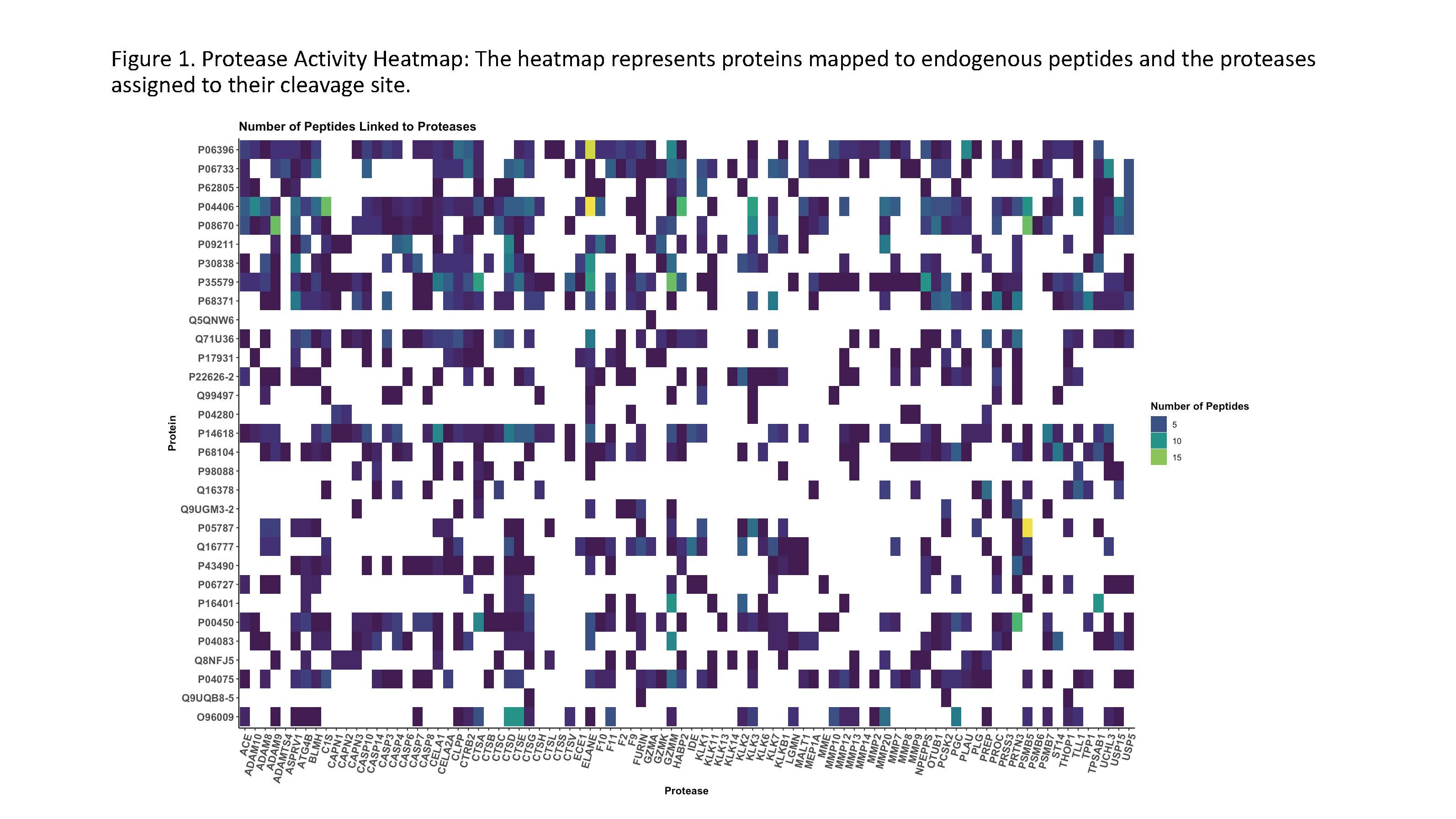
We identified 27 proteases that correlated with lung function. Proteases associated with low FEV1pp included myeloblastin, kallikrein, cathepsins, metalloproteinases, caspase and neutrophil elastase. Proteases associated with high FEV1pp included carboxypeptidase M, prothrombin, urokinase and gastricin. MS analysis of endogenous peptides identified 1402 proteins that mapped to these peptides, 28 of which were observed in individuals with significantly (FDR <= 0.1) lower average FEV1pp. The top five protease targeted proteins included: alpha-enolase, gelsolin, histone H4, tubulin beta-4B chain and histone H2B type 2-F. Pathway analysis revealed these proteins were associated with gene regulation and included SUMOylation, methylate and demethylate histones, and nucleosomes. The top five proteases demonstrating activity included: neutrophil elastase, granzyme M, cathepsin D, proteinase 3, and cathepsin E (Fig. 1).
Conclusions:
Like COPD unrelated to HIV, BALF protease abundance and activity is higher in individuals with HIV-associated OLD. We found that proteins involved in gene regulation are susceptible to these proteases as potential therapeutic targets.