Background:
Clonal hematopoiesis of indeterminate potential (CHIP) is associated with cardiovascular disease (CVD) and common in HIV, but whether CHIP contributes to atherosclerosis in HIV is unknown. We hypothesized that CHIP is associated with atherosclerosis, arterial inflammation, and hematopoietic activity among people with HIV (PWH).
Methods:
In this observational study, we studied treated, suppressed PWH ages 35-70 years old with ≥1 CVD risk factor. CHIP mutations were detected from peripheral blood mononuceleic cells with a validated targeted sequencing assay. We measured carotid intima-media thickness (IMT) longitudinally with ultrasound and aortic inflammation and hematopoietic metabolic activity using cross-sectional 18F-FDG-PET. Inflammatory biomarkers were measured with a multiplex electrochemiluminescence assay. We used linear regression with adjustment for age, sex, nadir CD4 count, smoking, hypertension, diabetes, and hyperlipidemia to adjust for potential confounders.
Results:
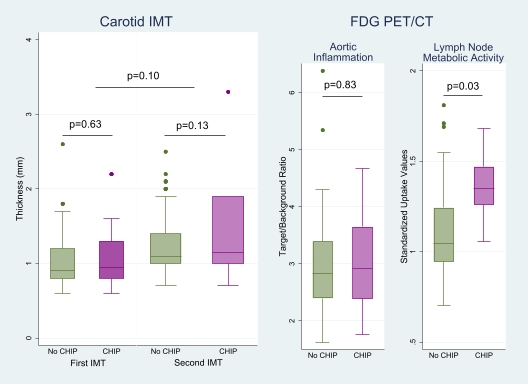
We included 231 PWH (52±9 years, 7% female). 32 (14%) had CHIP with median variant allele fraction of 3.1%. Common mutations were in DNM3TA (n=21) and TET2 (n=6). Only age was associated with CHIP (OR 2.3 per decade older, 95%CI 1.2-3.9; p=0.003. Among N=165 (CHIP=22), baseline mean IMT was 1.0 mm with and without CHIP (p=0.63), unchanged after adjustment (Figure). CHIP was not associated with prevalent (p=0.82) or incident plaque (p=0.48). Over 3.2 years, IMT progression was faster among those with CHIP (0.033 mm/year; p=0.10), attenuated after adjustment (0.022 mm/year; p=0.27). Among 80 with FDG-PET, CHIP (n=12) was associated with higher lymph node metabolic activity (p=0.03) that was attenuated in reference to background activity (p=0.69) and adjusted for risk factors (p=0.22), with a similar trend for spleen activity (p=0.14). CHIP was not strongly associated with arterial inflammation (p=0.83), bone marrow activity (p=0.50), inflammatory markers, or viral persistence markers.
Conclusions:
Among PWH, CHIP mutations were not associated with subclinical atherosclerosis or arterial inflammation, proposed mechanisms of how CHIP could cause CVD. Associations with lymph node and spleen activity suggests CHIP may be induced by HIV reservoirs or induce increased reservoir activity. Clinical outcomes studies are needed to ascertain the impact of CHIP on CVD in HIV.