Background:
Despite vaccination and antiviral therapies, immunocompromised individuals are at risk for prolonged SARS-CoV-2 infection, but the immune defects that predispose to persistent COVID-19 remain incompletely understood.
Methods:
Participants enrolled in the POSt-VaccInaTIon Viral CharactEristics Study (POSITIVES), a prospective cohort study enrolling participants with confirmed SARS-CoV-2 infection. Participants were categorized based on the extent of immunocompromise into severe hematologic malignancy/transplant group (S-HT), severe autoimmune/B-cell deficient (S-A), non-severe immunodeficiency (NS), and non-immunocompromised (None). Longitudinal nasal SARS-CoV-2 levels were measured with a quantitative PCR assay and viable virus levels were evaluated by viral culture. Neutralizing antibody, binding antibody to nucleocapsid, and T cell profiling (enzyme-linked immunosorbent spot [ELISpot] and Spike-specific proliferation assay) were performed in a subset of participants with available blood samples.
Results:
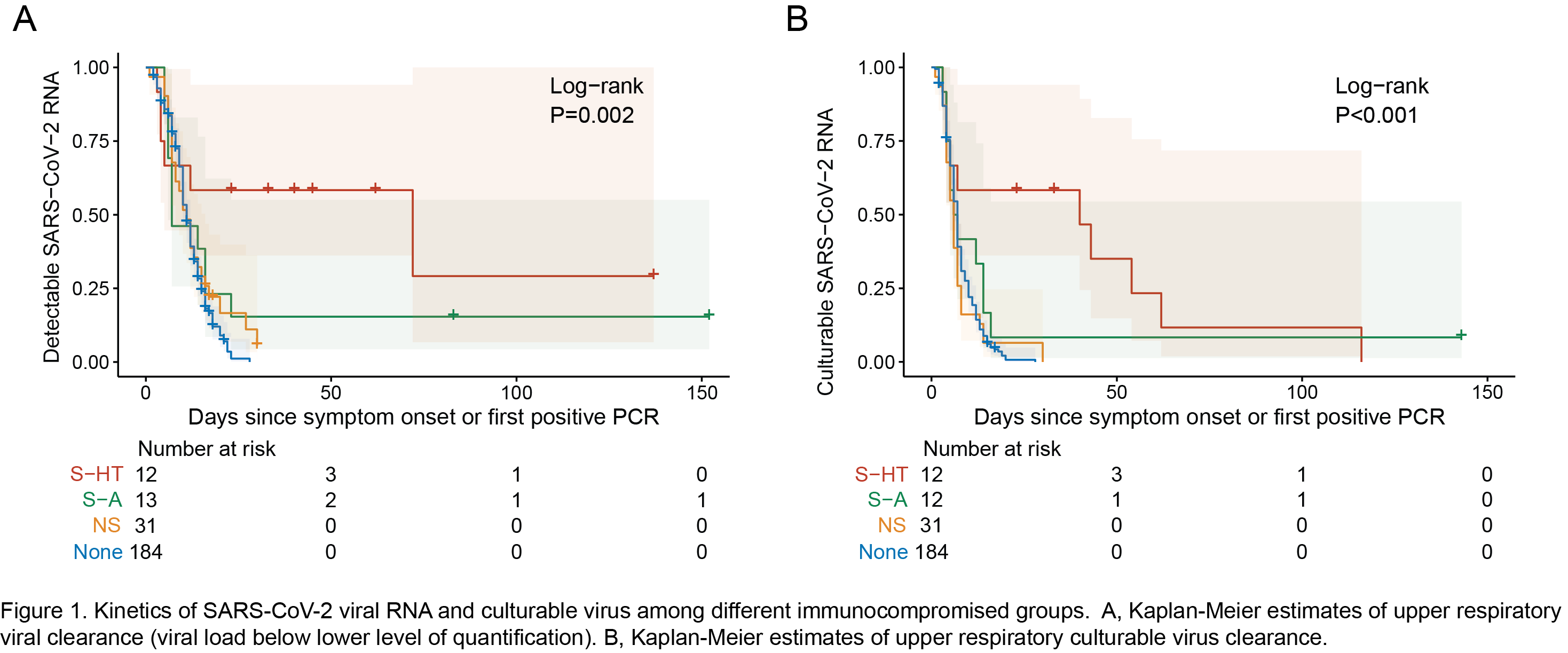
The median time to nasal viral RNA and culture clearance in the severe hematologic malignancy/transplant group (S-HT) were 72 and 40 days, respectively, which were significantly longer than clearance rates in the severe autoimmune/B-cell deficient (S-A), non-severe, and non-immunocompromised groups (P=0.002 Figure 1A and P<0.001 Figure 1B). Individuals with B-cell deficiency (S-A group) had an intermediate risk of persistent infection. Participants who were severely immunocompromised (S-HT and S-A) had greater SARS-CoV-2 evolution and a higher risk of developing antiviral treatment resistance. Both S-HT and S-A participants had severely diminished SARS-CoV-2-specific humoral responses. In contrast, S-A group had the highest level of SARS-CoV-2-specific CD4+ and CD8+ T cell proliferation response among all groups, while S-HT demonstrated neither antibody maturation nor increased T cell proliferation response to Spike peptide pools. NS and non-immunocompromised participants showed both increasing neutralizing antibody levels (until a plateau ~25-30 days post symptom onset) and SARS-CoV-2-specific T cell responses.
Conclusions:
Our study demonstrated a hierarchy of immunocompromised conditions that increase the risk of delayed viral clearance and SARS-CoV-2 evolution, with the highest risk in those with severe hematologic malignancy/transplant. The findings may be explained by the suppression of both SARS-CoV-2-specific B and T cell responses.